Warehouse Automation Opportunity Value
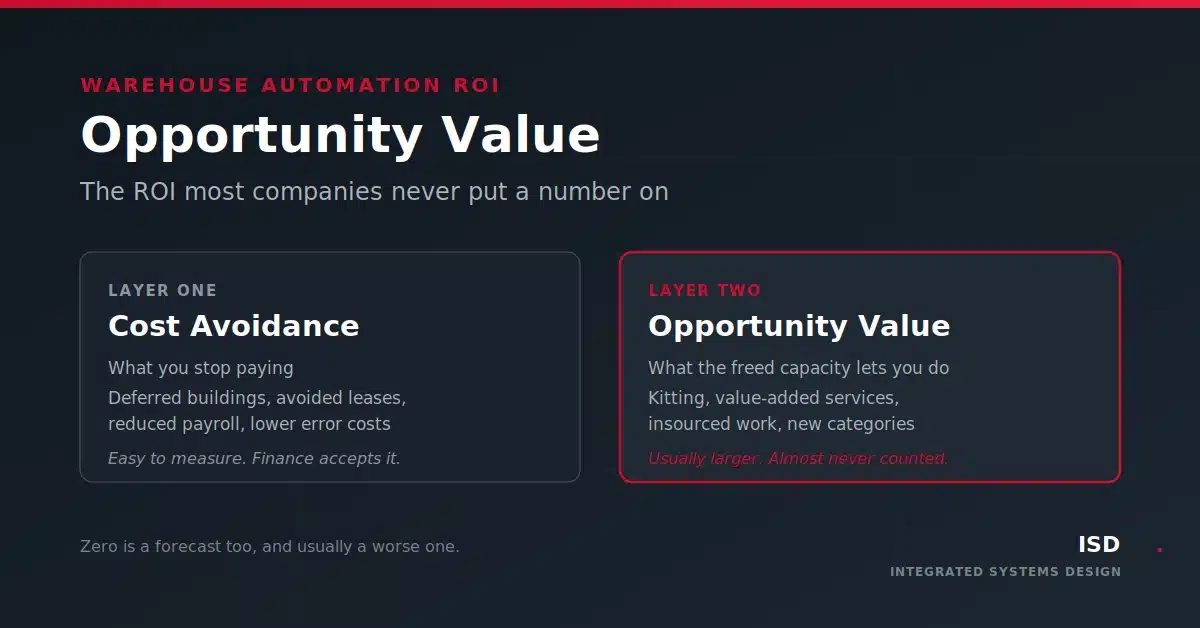
Warehouse automation ROI has two layers. There is the cost you avoid, which is easy to measure. And there is the opportunity value of what you do with the space and labor automation frees, which is usually larger and almost never counted.
Cost avoidance is straightforward. Recover 20,000 square feet and you defer a building. Cut 12 picking positions and payroll drops. Those numbers go in a spreadsheet cell and finance accepts them.
Opportunity value is different in kind. The recovered space does not just sit there as an avoided cost. It becomes a kitting line, a value-added services operation, insourced work you used to outsource, or a new product category. The operators freed from picking, packing, and shipping move to quality, exception handling, and customer-facing fulfillment. That is not subtraction. That is new margin the operation could not generate before.
This guide is for the operations and finance leaders who want the full return in their business case, the reality rather than the easy answer.
On this page
Cost Avoidance and Opportunity Value Are Not the Same Number
Most ROI analyses stop at cost avoidance. It is the defensible half of the return, and it is where the calculator ends.
Cost avoidance answers one question: what do we stop paying? Deferred construction, avoided leases, reduced payroll, lower error costs. Real money, and countable.
Opportunity value answers a different question: what can we now do that we could not do before? That answer depends on your business, not on the equipment. Two companies can install the same system and generate completely different opportunity value, because one turns the recovered space into a value-added services line and the other leaves it empty.
That dependence is exactly why it gets left out. And leaving it out is a choice with a cost.
“The cheapest part of the project to justify is the labor line. The part that changes the business is what you build in the space you get back. Many business cases never put a number on that, so it defaults to zero, and zero is the one number we know is wrong.”
Bob Jones, Senior Consultant, ISD
Why Many Business Cases Record It as Zero
Finance does not ignore opportunity value because it doubts the concept. It ignores it because the number is hard to defend.
It depends on decisions not yet made. Cost avoidance is locked in by the system design. Opportunity value depends on what leadership chooses to do with the freed capacity, and that choice often has not been made when the capital request is written, or leadership does not want to go on record.
It requires assumptions finance did not make. Estimating margin on a kitting line or an insourced service means forecasting revenue, and operations is not usually the group that forecasts revenue.
It looks like advocacy. A number that makes the project look better, produced by the team that wants the project approved, invites skepticism. Teams leave it out to protect their credibility on the rest of the case.
There is no standard method. Payback, IRR, and NPV have accepted formulas. Opportunity value does not, so each analyst creates one, and inconsistent methods get discounted.
Every one of those reasons is understandable. None of them makes zero the right answer. Zero asserts that the freed capacity will produce nothing, which is a forecast too, and usually a worse one.
Where Opportunity Value Actually Comes From
Opportunity value shows up in two currencies: recovered space and redeployed people.
Kitting and light assembly. High-density storage frees floor area that can host kitting, sub-assembly, or configuration work. That work carries margin and often shortens lead times for your customers.
Value-added services. Labeling, custom packaging, personalization, gift wrapping, and compliance work are services customers pay for. They need space and hands, and automation gives you both.
Insourcing outsourced work. Work you send to a third-party logistics provider, or contract packager can come back in house when you have capacity. You capture the margin you were paying away.
New product categories or channels. Recovered capacity lets you carry SKUs you could not stock before, or serve a channel like ecommerce or retail replenishment that needs its own space.
Redeployed labor. Operators freed from picking move to quality control, exception handling, returns processing, and customer service. Those roles reduce cost in some cases and generate retention and revenue in others.
Growth you can absorb without expanding. Capacity headroom means the next growth year does not trigger a building project. That is not the same as the avoided-building line, because it recurs every year that the headroom lasts.
“We tailor the system to your operation, not your operation to the system. That means asking what you want the freed space to become before we design it. A system that only removes cost is a smaller project than one that also creates capacity you can sell.”
Tony Morgott, President, ISD
Start with the numbers you can already prove
Enter your facility’s operating data and get payback, IRR, NPV, and total ROI in a board-ready PDF, then layer opportunity value on top.
How to Quantify Opportunity Value
You do not need a perfect number. You need a defensible one, presented honestly as a range with its assumptions visible. Here is a method that survives CFO review.
- Measure the freed capacity. Quantify what the system actually returns: square feet recovered, positions freed, and hours released per shift. These come from the system design, so they are the firmest inputs you have.
- Name the specific use. Do not value capacity in the abstract. Pick the actual intended use: a kitting cell, an insourced packaging operation, a new SKU category. A named use can be modeled. Unnamed capacity cannot.
- Model the margin, not the revenue. Estimate contribution margin from that use, not top-line revenue. Finance will discount the revenue number and accept a margin number, because margin already nets out the cost to deliver.
- Apply a confidence discount. Take your estimate and cut it. A 50 percent haircut on an opportunity-value line is common and signals that you understand the uncertainty. A discounted number that gets counted beats a full number that gets thrown out.
- Decide how far to carry it into the case. This is a judgment call, and it should match how predictable the opportunity is and how your organization builds capital requests. A conservative approach keeps the base case on cost avoidance alone and presents opportunity value as a clearly labeled upside layer with its assumptions listed. A more aggressive approach includes it in the primary return, which is defensible when the intended use is already decided, the margin is known from existing operations, and leadership has committed to the plan. Most cases land in between. The test is whether you could defend the number to your board without hedging. If you are unsure where your situation falls, ISD can help you evaluate it. We have seen how these cases are received across many operations and industries, and we can help you judge which approach your numbers will support.
- Tie it to a decision date. State when the capacity comes online and when the new use starts. An opportunity with a date is a plan. One without a date is a hope.
Presented this way, opportunity value strengthens your case instead of undermining it. You are not asking finance to trust a number. You are showing them a method, and letting the strength of the underlying business decide how much weight it carries.
What This Changes About Your Business Case
A business case built only on cost avoidance answers whether you can afford the system. A case that includes opportunity value answers what the system makes possible.
The practical difference shows up in scope. Cost-avoidance thinking sizes a system to today’s volume, because every additional dollar has to justify itself against labor savings alone. Opportunity-value thinking asks what capacity is worth having, which often supports a design that serves the business for longer.
It also changes which projects get approved. Two systems with identical payback periods are not equally valuable if one leaves you with 30,000 square feet you can monetize and the other does not.
How ISD Approaches Opportunity Value
ISD is a systems integrator, not a single-solution vendor, so our recommendations are shaped by your operation rather than by a catalog.
Our OptimalOps-Process framework starts by modeling your current operation and your future requirements. That includes what you intend to do with recovered space and redeployed people, because the answer changes the design. A system built to free capacity for a kitting line looks different from one built only to cut picking labor.
The ROI calculator will give you the cost-avoidance half of the return in about 10 minutes. Opportunity value takes a conversation, because it depends on your business strategy and not on the equipment. That is the number no calculator hands you.
For the full picture of how automation returns are measured, see our pillar article on warehouse automation ROI. To work through the cost-avoidance half in detail, see our ROI calculator guide.
To compare how funding structures affect the return, see our guides to CapEx vs OpEx warehouse automation, the hidden costs of RaaS and SaaS warehouse automation, and warehouse automation financing.
Build your CFO-ready case
Run the ROI Calculator, then talk to ISD about what your recovered space and labor could become.
Warehouse Automation Opportunity Value: Questions and Answers
What is opportunity value in warehouse automation ROI?
Opportunity value is the new margin an operation earns by redeploying the space and labor that automation frees. Cost avoidance measures what you stop paying. Opportunity value measures what the recovered capacity lets you start doing, such as kitting, value-added services, insourced work, or new product lines.
Why is opportunity value left out of most ROI analyses?
Because it is harder to defend. It depends on decisions leadership may not have made yet, it requires revenue assumptions operations does not normally make, and there is no standard formula for it. So, many business cases record it as zero, which is almost always the wrong number.
How do you calculate opportunity value?
Measure the freed capacity, name the specific use for it, model the contribution margin from that use, apply a confidence discount, decide how far to carry it into the case, and tie it to a date. The goal is a defensible range with visible assumptions, not a precise figure.
Is opportunity value bigger than labor savings?
Often, but not always. For an operation that redeploys recovered space into a margin-generating activity, opportunity value can exceed the labor line substantially. For an operation that leaves the space empty, it is zero. The difference is what you decide to do with the capacity.
Should opportunity value be included in the payback calculation?
It depends on how predictable the opportunity is and how your organization builds capital requests. The conservative approach keeps the base case on cost avoidance alone and shows opportunity value as a labeled upside layer. A more aggressive approach includes it in the primary return, which is defensible when the intended use is decided, the margin is known from existing operations, and leadership has committed. Judge it by whether you could defend the number to your board without hedging, and talk to ISD if you want help deciding which approach fits your situation.
Does the ROI calculator include opportunity value?
No, and that is deliberate. A calculator can model labor, throughput, and cost avoidance from your operating data. Opportunity value depends on your business strategy and what you choose to do with freed capacity, so it takes a conversation rather than a form.