
CapEx vs OpEx warehouse automation
CapEx vs OpEx warehouse automation decisions come down to how your operation behaves, not which option looks cheaper on day one. CapEx means you buy and own the system. OpEx means you subscribe, lease, or pay as you use it. Both can fund the same automation. They just place the cost, the risk, and the ownership in different hands.
This guide is for the operations and finance leaders deciding which path fits. It walks through what separates the two models, the seven factors that should drive your choice, and why the cheapest-looking option is often not the least expensive over time.
On this page
What CapEx and OpEx Actually Mean
The labels describe where the cost lands on your books.
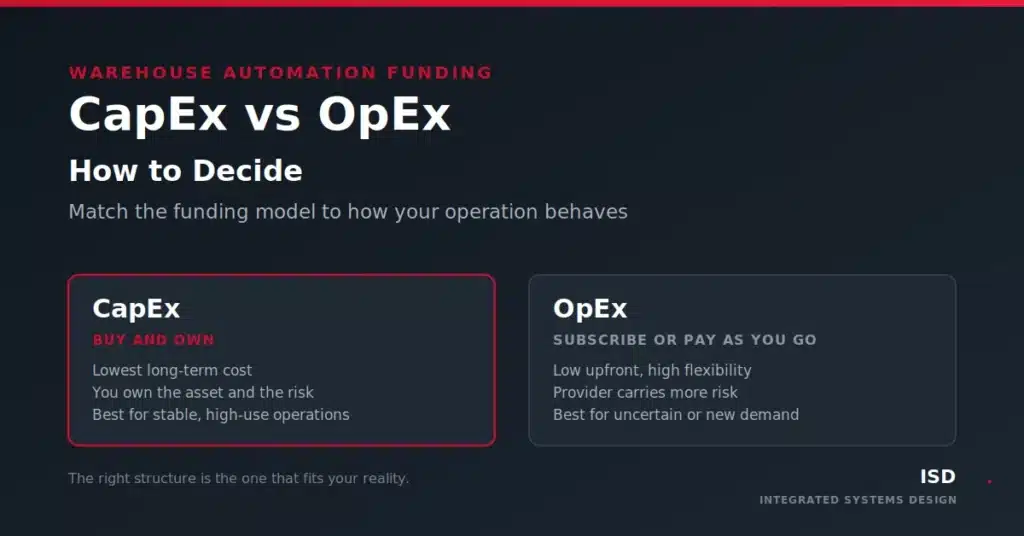
A CapEx model is a capital purchase. You buy the equipment, capitalize it as an asset, and depreciate it over its useful life. You own it. You also carry the upfront cost and the risk that your volume assumptions hold.
An OpEx model turns the system into a recurring expense. This includes robotics as a service, software as a service, subscription automation, and usage-based pricing. You do not own the asset. You pay for access and flexibility, and the provider carries more of the risk.
Leasing sits between the two. You commit to a defined system but spread payments over a term. Depending on the terms, a lease can behave more like CapEx or more like OpEx. For this decision, treat leasing as a bridge, not a separate camp.
The Core Tradeoff
Every funding model shifts the same four variables: when cash goes out, how much flexibility you keep, who owns the asset, and who carries the risk if the plan changes.
CapEx favors long-term cost control. You absorb the upfront investment and the utilization risk. In return, you capture the full benefit when the system performs, and your cost per unit improves as volume grows.
OpEx favors flexibility and risk transfer. You lower the capital barrier and move faster. That flexibility has a price. It shows up over time as recurring payments, and subscription rates often rise at renewal unless you negotiate limits.
The real question is not which model is cheaper. It is what you are trying to optimize: cash flow, flexibility, long-term cost, speed, or risk transfer. Name that first, and the choice gets clearer.
“Most automation projects do not fail on the floor. They fail in the boardroom, when the funding model does not match how the business actually runs. Get that match right and you clear the approval bar before you pitch.”
Bob Jones, Senior Consultant, ISD
Seven Factors That Should Drive Your Choice
Most companies sense which way they lean. These seven factors turn that instinct into a defensible decision.
- Cash position. How much upfront capital can the business absorb without straining other priorities? Strong cash and a stable balance sheet favor CapEx. Tight capital or competing demands favor OpEx.
- Demand predictability. Stable, well-understood volume favors owning the asset. Uncertain or fast-shifting demand favors the flexibility of OpEx. The question is not whether you will grow. It is whether you know the shape of that growth.
- Balance sheet strategy. CapEx puts the asset on your balance sheet and lets you depreciate it. OpEx keeps it off, as an operating expense. Which treatment serves your financial reporting goals?
- Tax and depreciation. Many qualifying automation assets may be eligible for significant first-year bonus depreciation under current U.S. tax law. If that benefit is worth more to you than expensing flexibility, CapEx gains an edge. Consult your tax advisor, because eligibility depends on your position.
- Time horizon. How long will you run the system? OpEx costs less to start but more the longer it runs. Over a long, stable life, ownership usually wins on total cost. For a short or uncertain horizon, OpEx protects you.
- Risk tolerance. If volume assumptions break, who absorbs it? Under CapEx, you do. Under OpEx, the provider carries more of that risk. Decide how much uncertainty you want to own.
- Strategic signal. Your funding choice tells your CFO and board how you manage capital. CapEx signals conviction in a stable, long-term plan. OpEx signals a deliberate hedge against uncertainty. Neither is wrong. They simply say different things.
Why OpEx Looks Cheaper Than It Is
The most common mistake in this decision is reading a high IRR as a low cost.
Low-upfront models like OpEx and leasing can post a very high IRR. That happens because the initial cash outlay is small, not because the total cost is low. The return looks strong relative to the money you put in. It says nothing about what you pay over the full term.
Run the system long enough and recurring payments can exceed what a purchase would have cost. Subscription rates also tend to climb at renewal. So, a model that wins on day one can lose over seven years.
This is why IRR and NPV belong together. IRR shows the return on your outlay. NPV shows the total value in today’s dollars. Read them side by side, or the easy number wins the argument it should not. For a full walkthrough of how these metrics work together, see our Warehouse Automation ROI Calculator guide.
“When a customer shows me an OpEx quote with a huge IRR, I ask one question: what does this cost in year seven? Low upfront and low total are not the same thing. A CFO knows the difference, and so should the operator making the case.”
Bob Jones, Senior Consultant, ISD
See how the models compare on your numbers
Enter your facility’s operating data and get payback, IRR, NPV, and total ROI in a board-ready PDF.
When Each Model Fits Best
The factors above usually point in a consistent direction. Here is how they tend to resolve.
CapEx fits a stable operation with strong utilization, available capital, and a long time horizon. If you know the shape of demand and plan to run the system for years, ownership delivers the lowest total cost and the full benefit of the asset.
OpEx fits an uncertain or evolving operation. If you are entering new markets, testing a channel, or unsure how volume will develop, OpEx buys flexibility and transfers risk. You pay more over time for the option to change course.
Many operations land in between, and that is not a failure to decide. A stable core paired with uncertain peaks often calls for a hybrid: own or lease the base system, and use subscription or usage-based capacity for the variable part. That approach matches the funding model to how the business actually behaves.
“We tailor the system to your operation, not your operation to the system. The same discipline applies to how you fund it. The right structure is the one that fits your reality, not the one that sounds best in a sales deck.”
Tony Morgott, President, ISD
How to Make the Decision
Do not start with CapEx or OpEx. Start with the operation.
Ask how predictable your demand is, how stable your order profile is, how much capital you can absorb, how long you will run the system, and what happens if volume grows faster or slower than planned. Those answers point to a model before you compare a single number.
Then test the options side by side using the same assumptions. Compare upfront cost, recurring cost, implementation, maintenance, tax treatment, depreciation, payback, IRR, NPV, and total cost of ownership. Judge them together. Without that full view, the decision gets biased by whichever number is easiest to see. Our OptimalOps-Process framework models your operation before recommending a configuration, so the funding comparison rests on real numbers rather than assumptions.
For a complete comparison that adds leasing, variable, and hybrid structures to this CapEx-versus-OpEx choice, see our guide to warehouse automation financing. To see where this decision fits in the bigger picture, start with our pillar on warehouse automation ROI. If you are leaning toward a subscription model, review the hidden costs of RaaS and SaaS warehouse automation first. And for the return that most cases miss entirely, see warehouse automation opportunity value.
Build your CFO-ready case
Run the ROI Calculator, then talk to ISD to pressure-test the numbers and match the funding model to your operation.
CapEx vs OpEx for Warehouse Automation: Questions and Answers
Is CapEx or OpEx better for warehouse automation?
Neither is better in every case. CapEx usually delivers the lowest long-term cost when the asset is well utilized and demand is stable. OpEx lowers upfront cash and adds flexibility, but recurring payments can raise total cost over time. The right choice depends on demand predictability, cash position, time horizon, and how much risk you want to own.
Why does OpEx often show a higher IRR than CapEx?
IRR measures return relative to the initial cash outlay. Low-upfront models like OpEx and leasing can post a very high IRR because you put in little at the start. That does not mean the lowest total cost or the best value. Read IRR alongside NPV and total cost of ownership.
Does an OpEx or RaaS model remove all upfront costs?
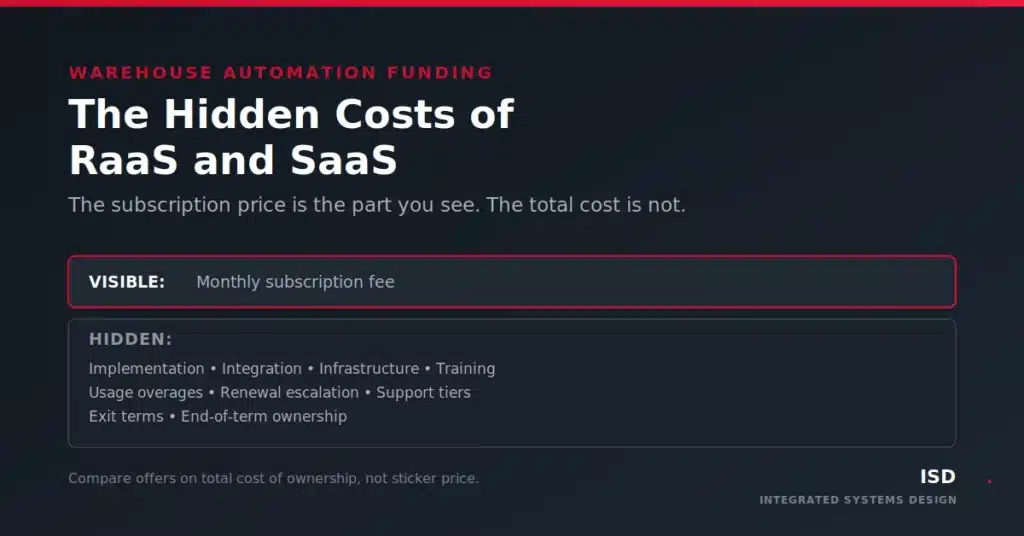
No. Design, site assessment, integration with your WMS and WCS, training, infrastructure upgrades, and commissioning usually fall outside the recurring fee. On some projects, first-year implementation can exceed the subscription. Separate one-time costs from recurring fees when you compare.
Can bonus depreciation change the CapEx decision?
It can. Many qualifying automation assets may be eligible for significant first-year bonus depreciation under current U.S. tax law. That accelerates the tax benefit and improves first-year cash flow, though it does not change the total deducted. Confirm eligibility with your tax advisor.
When does a hybrid model make sense?
When you have a stable core and uncertain peaks. Own or lease the base system for predictable volume, then use subscription or usage-based capacity for seasonal or unproven demand. A hybrid matches fixed cost to fixed need and flexible cost to flexible need.
How do I compare CapEx and OpEx fairly?
Model both with the same operating assumptions over the same period. Include upfront cost, recurring cost, implementation, maintenance, tax effects, depreciation, payback, IRR, NPV, and total cost of ownership. Comparing only upfront price or only IRR will mislead you.