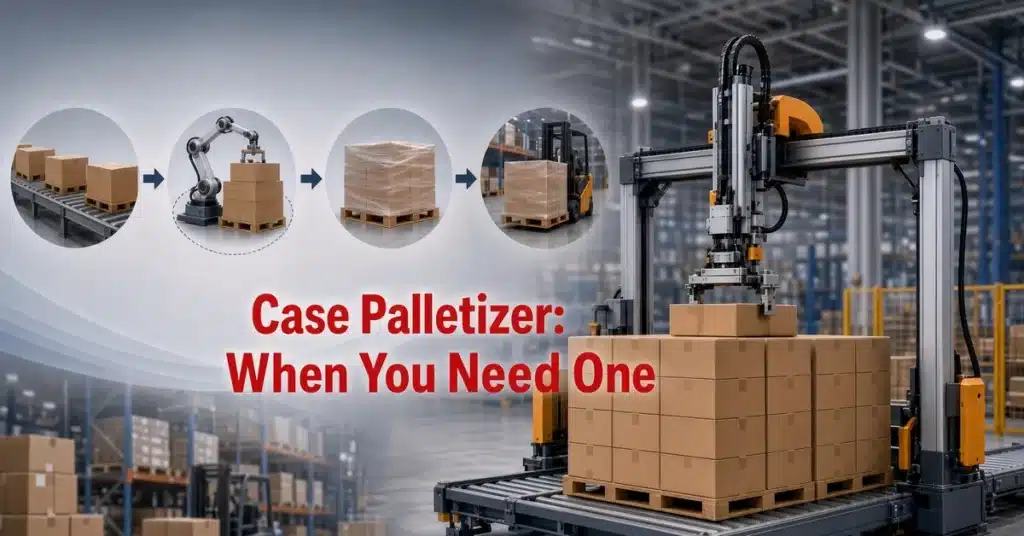
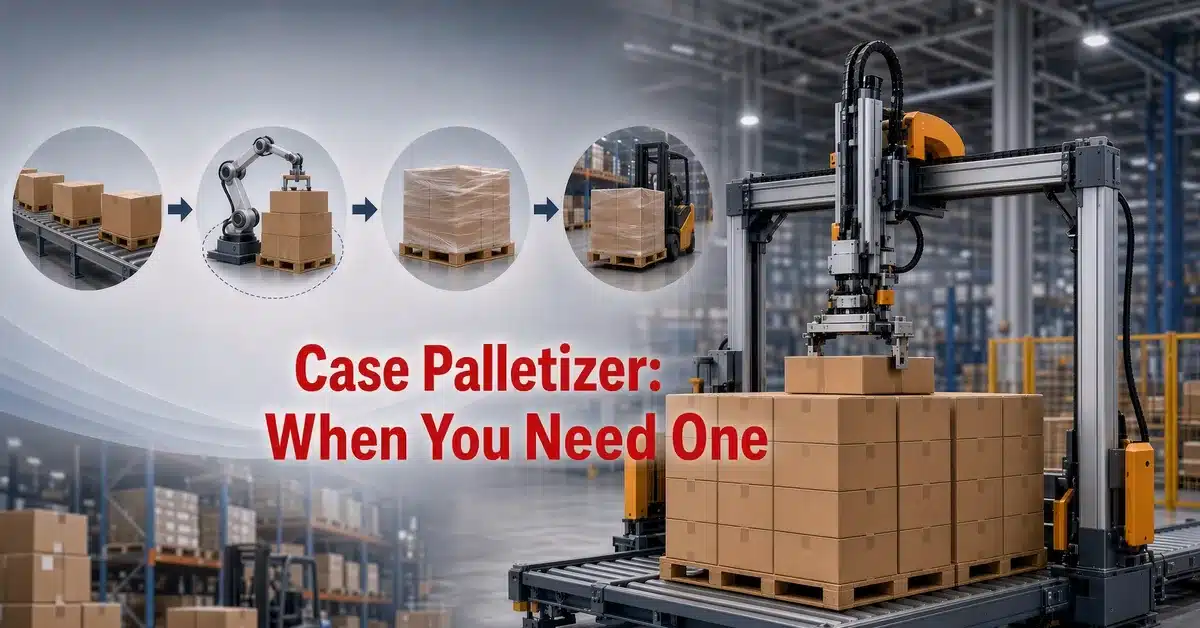
A case palletizer is a robot or machine that stacks cartons and boxes onto a pallet in a defined pattern. Cases move off a conveyor, get arranged layer by layer, and get placed onto the pallet until it’s full. That’s the core function. The harder question is whether the case palletizer you found online actually fits your product and volume.
On This Page:
Before You Shop by Brand
Most of what shows up when you search for a case palletizer is a manufacturer selling its own equipment. That’s useful for comparing specs, but specs alone don’t tell you which type of machine fits your operation. A high-speed conventional unit and a flexible robotic cell might both get called a case palletizer. They solve very different problems.
The type you need depends on your case size and your volume. It also depends on how often your packaging changes, not which brand has the best landing page. Getting that fit wrong is expensive to undo once a machine is installed. A quick self-check before you start comparing brands saves real rework later.
Conventional vs. Robotic Case Palletizers
Conventional case palletizers use a fixed mechanical arm or layer-forming table built for one case size and one pattern. They run fast and cost less upfront, which suits a single product line that rarely changes. The Packaging Machinery Manufacturers Institute covers this equipment category alongside the rest of the packaging line. Robotic case palletizers use a multi-axis arm that can switch between case sizes and patterns without new hardware.
“A conventional case palletizer is a great machine right up until your packaging changes. Then you’re either buying new tooling or living with a machine that only half fits the job. That’s the tradeoff nobody puts on the spec sheet.”
Signs You Need a Case Palletizer
A few signs point toward needing a case palletizer, rather than a different palletizer type or no automation at all:
- Manual case stacking is a regular bottleneck at the end of your line
- Your product ships in cartons or boxes, not bags or loose bulk
- Case dimensions are consistent enough for a machine to learn the pattern
- Injury reports or turnover trace back to repetitive lifting at the palletizing station
None of these alone means you need one tomorrow. Together, they’re worth a real conversation. Consistent case construction also matters for transit. Groups like the International Safe Transit Association publish standards for how cartons hold up once they leave your dock.
Case Palletizer vs. Other Palletizer Types
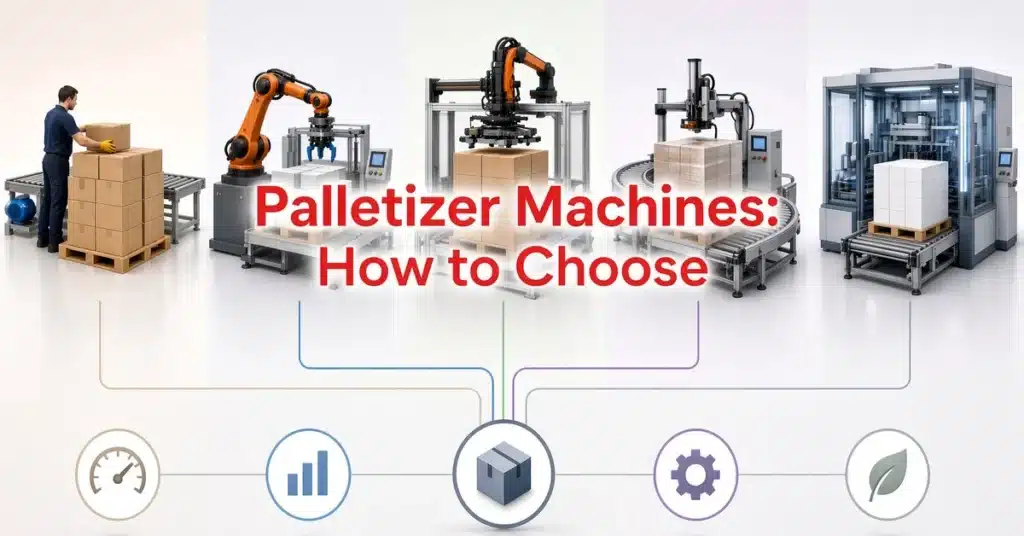
Case palletizers are one category among several. Bag palletizers handle powders and bulk bagged product instead of cartons. Layer palletizers build a full layer at once rather than picking individual cases. Mixed-load palletizers handle multiple SKUs on one pallet. Our full palletizer machine guide covers all of these types side by side.
“Case palletizing looks simple because cartons are simple. But matching the right robot and gripper to your specific case still takes real evaluation, not a catalog pick. The cases that look easiest on paper are often the ones that trip people up.”
Manufacturer or Integrator?
Buying a case palletizer directly from a manufacturer works well in one situation. You already know exactly which machine you need, and it’s the only piece of the project. Most operations aren’t in that position. The palletizer has to fit an existing conveyor. It has to fit an existing floor plan. It has to handle a product mix that might not match the manufacturer’s demo unit.
“A manufacturer will always recommend their own machine. That’s not a criticism, it’s just the business model. An integrator starts from your product and your line, and the palletizer is one decision inside that, not the only one.”
That’s the real fork most people searching for a case palletizer haven’t hit yet. ISD evaluates conventional and robotic options across multiple manufacturers. We recommend the one that actually fits, rather than defaulting to one product line because that’s what we sell.
Our Palletizing Module page covers the full technology. Our robot and tooling guide covers matching equipment to product. Our readiness guide helps you figure out if now is the right time. Our end-of-line automation guide covers what surrounds the palletizer itself.
Frequently Asked Questions
What is a case palletizer?
A case palletizer stacks cartons and boxes onto a pallet in a defined pattern. It replaces manual case stacking at the end of a line.
Should I buy a case palletizer directly from a manufacturer?
If you already know exactly which machine fits and it’s a standalone purchase, yes. If it needs to fit your existing line, an integrator with no single-brand allegiance usually finds a better fit.
What’s the difference between a conventional and a robotic case palletizer?
Conventional machines run fast and cost less but handle one case size and pattern. Robotic machines cost more upfront but adapt to different cases and patterns without new hardware.
How is a case palletizer different from a bag or layer palletizer?
A case palletizer is built for cartons and boxes specifically. Bag palletizers handle bulk bagged product, and layer palletizers build a full layer at once rather than picking individual cases.
What information do I need before evaluating case palletizers?
Case dimensions and weight both matter, along with your target cycle rate. How often your packaging changes also helps determine the right type and size of machine.
About ISD
ISD is a systems integrator specializing in warehouse, distribution, and manufacturing operations. ISD is also an OEM provider of the UltraStore Mid-Load ASRS system. ISD’s proprietary OptimalOps-Process uses an 8-step framework to improve operational efficiency and reduce costs. It also speeds up ROI across picking, sorting, packing, and shipping.
ISD works closely with clients to define objectives, analyze data, and build tailored solutions. We do not sell one case palletizer brand and call it the answer for every operation. Our offerings span conveyor systems, ASRS, AMRs, robotics, sortation, warehouse software, pallet handling, and order fulfillment technologies. Learn more at www.isddd.com.
Before You Pick a Case Palletizer by Brand, Find Out What Actually Fits
Schedule a consultation with ISD, or see the full Palletizing Module page for the bigger picture.