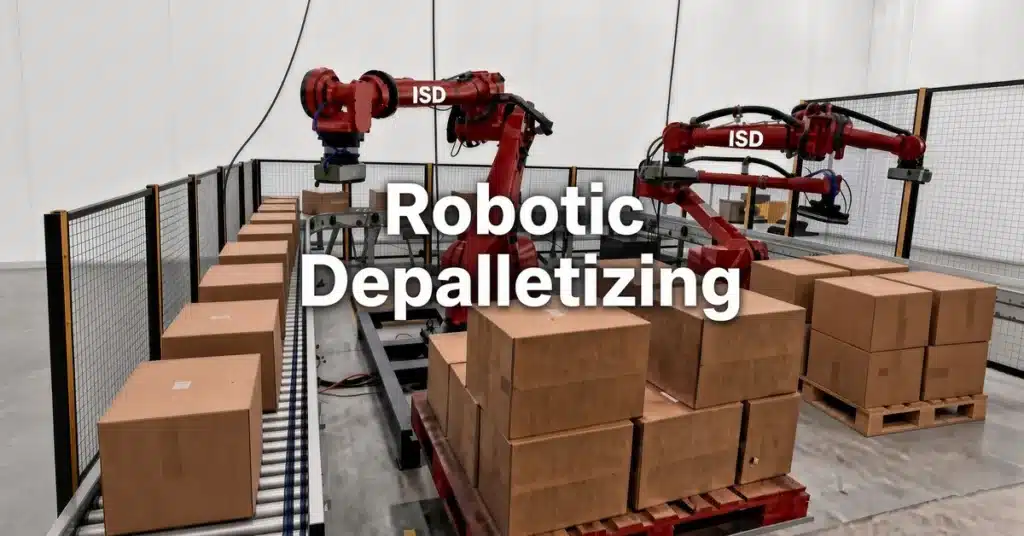
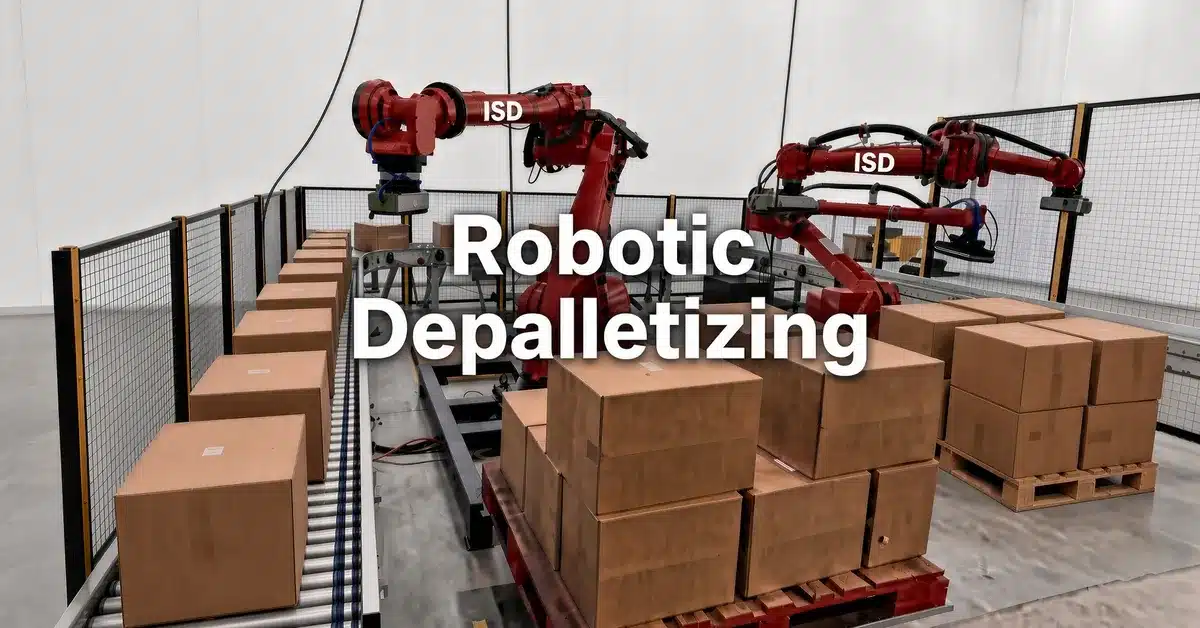
A depalletizing robot does the reverse of a palletizer. Instead of building an outbound pallet, it unloads an incoming one, case by case. That product then feeds production, storage, or piece-picking. A depalletizing system is usually the first automation opportunity most operations overlook.
On This Page:
What Is a Depalletizing Robot?
Robotic depalletizing removes cases, bags, or totes from an incoming pallet in a controlled sequence. The product then moves onto a conveyor, into a production line, or toward a piece-picking system.
Palletizing and depalletizing look like mirror images, but depalletizing is often the harder problem. Outbound pallets are built to a pattern you control. Inbound pallets arrive built by someone else, often with less consistency. That difference shapes almost every equipment decision in a depalletizing cell.
Common Applications for Robotic Depalletizing
Robotic depalletizing shows up anywhere product needs to leave a pallet before it can be used. It is often the first automation project a facility takes on, since receiving volume is usually steady and predictable. Common applications include:
- Feeding raw material into a production or assembly line
- Unloading mixed-SKU pallets to sort into storage or picking
- Inducting cases onto a conveyor for downstream processing
- Staging bulk or bagged product for further packaging
- Receiving dock automation for high-volume inbound freight
Food and beverage, manufacturing, and 3PL operations see the heaviest depalletizing volume. All three receive large amounts of inbound product that has to come off the pallet before it becomes useful. Groups like the Material Handling Institute track robotics adoption trends across exactly these industries. That volume is exactly why the receiving dock is worth a closer look before you focus automation dollars elsewhere.
Robot and Vision Requirements for a Depalletizing System
Depalletizing usually asks more of the vision and sensing system than palletizing does. A palletizing robot builds a pattern it already knows. A depalletizing robot has to recognize whatever pattern arrived on the truck.
That means vision systems need to identify case position, orientation, and sometimes SKU, all without a fixed reference pattern. Mixed pallets raise the bar further, since the robot has to sort as it unloads. The Association for Advancing Automation’s Vision and Imaging Hub tracks this kind of machine vision development. Perception is usually the limiting factor here.
“People underestimate depalletizing because it looks like palletizing in reverse. The physical motion is similar, but the perception problem is completely different. The robot has to figure out what it’s looking at before it can move anything, and that takes real vision capability, not just a program running the same motion twice.”
Challenges Unique to Depalletizing
A few challenges show up specifically on the depalletizing side. Incoming pallets are not always built to spec, and a robot has to handle that variability without stopping the line. Product can arrive damaged or shifted, which complicates a clean pick. Supplier packaging is not always consistent, even for the same SKU. Height and weight can vary pallet to pallet too, which affects how the robot plans its approach on each layer.
“You cannot control what shows up on your dock the way you control what leaves it. A depalletizing cell has to be designed for the pallets you actually receive, not the pallets you wish you received.”
Sharing One Cell With Palletizing
Many operations do not need a separate depalletizing cell and a separate palletizing cell. The same robot, on a different schedule, can often do both.
“We size a lot of cells to run depalletizing in the morning and palletizing in the afternoon. It depends on your shift pattern and your volumes, but sharing one cell can cut both cost and floor space. It’s one of the first questions we ask during a consultation, because it changes the whole design.”
Depalletizing rarely stands alone in a project. Our Palletizing Module page covers the full picture of both directions. Our robot and tooling guide covers how ISD matches equipment to product. Our readiness guide helps you figure out if now is the right time. Our types of palletizer machines guide compares equipment types at a broader level, and our case palletizer guide covers that specific category in depth.
Our Is This a Good Palletizing Application? checklist works for depalletizing too. It is a fast way to see where your operation stands before you schedule a call.
Frequently Asked Questions
What is the difference between palletizing and depalletizing?
Palletizing builds an outbound pallet in a controlled pattern. Depalletizing removes product from an incoming pallet that was built somewhere else, often with less consistency.
Can one robot handle both palletizing and depalletizing?
Often, yes. It depends on your shift pattern and volumes. ISD evaluates this during a consultation rather than assuming either way.
What makes depalletizing harder than palletizing?
Incoming pallets are not built to your spec. The robot and vision system have to handle variability instead of executing a known pattern.
What industries use robotic depalletizing the most?
Food and beverage, manufacturing, and 3PL operations see the heaviest use. All three receive high volumes of inbound product that must come off the pallet before it can be used.
What should I prepare before a depalletizing consultation?
Photos or samples of typical incoming pallets and your receiving volume both help. So does any known SKU or packaging variability, since it helps ISD scope the right system faster.
About ISD
ISD is a systems integrator specializing in warehouse, distribution, and manufacturing operations. ISD is also an OEM provider of the UltraStore Mid-Load ASRS system. ISD’s proprietary OptimalOps-Process uses an 8-step framework to improve operational efficiency and reduce costs. It also speeds up ROI across picking, sorting, packing, and shipping.
ISD works closely with clients to define objectives, analyze data, and build tailored solutions. Our offerings span conveyor systems, ASRS, AMRs, robotics, sortation, warehouse software, pallet handling, and order fulfillment technologies. Learn more at www.isddd.com.
Ready to See if Robotic Depalletizing Fits Your Receiving Operation?
Schedule a consultation with ISD, or see the full Palletizing Module page for the bigger picture.