This Warehouse Automation ROI Calculator and warehouse automation IRR are easy to use and provide CFO-ready data. Determine your warehouse automation IRR and automation payback period quickly and easily. This practical guide is for supply chain, distribution, assembly, and maintenance leaders who need to justify an automation investment and want to cover all your bases. Plus, you can eliminate the DIY work by contacting ISD’s Senior Solutions Consultant, who will walk you through and help you complete the calculations at no obligation.
This Warehouse Automation ROI Calculator calculates your warehouse automation IRR and the automation payback period.
You see the pain points every day. Picking labor costs is climbing, and the total cost of ownership is not calculated. Accuracy drifts. Throughput hits a ceiling. Seasonal labor is harder to find and more expensive to keep. The operational case for warehouse automation IRR is obvious to you.
Obviously, it doesn’t get signed. Finance needs specific numbers, structured the way your CFO evaluates every capital request. If you run supply chain, distribution, assembly, or maintenance operations, that gap between the floor and the finance office is often the only thing standing between you and a green light.
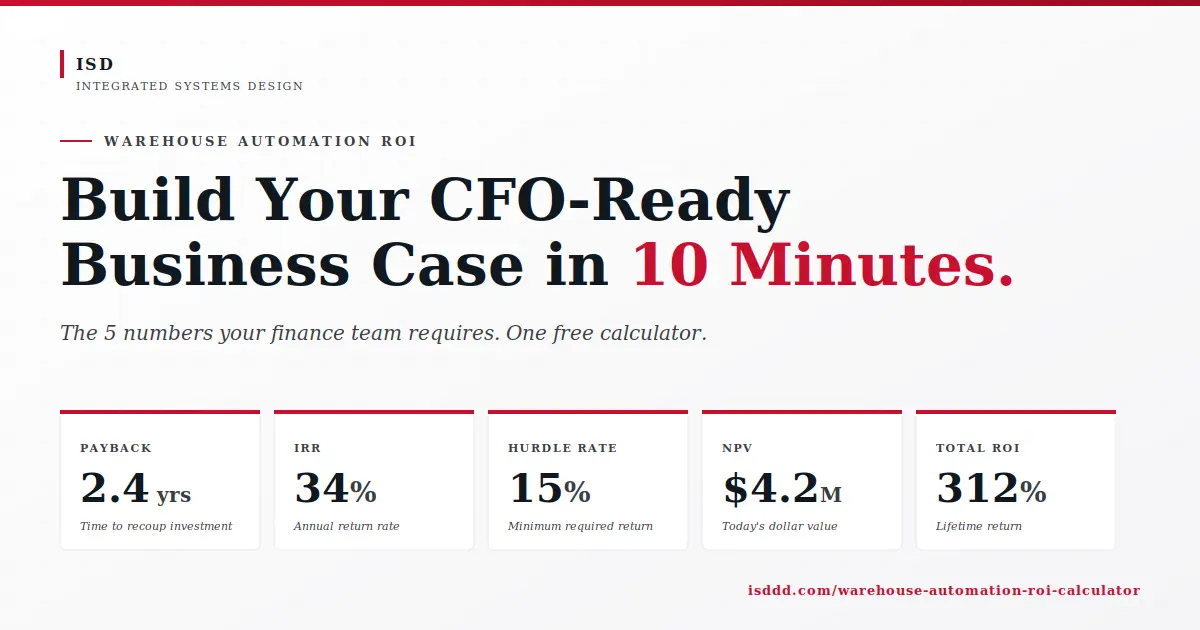
ISD’s new Warehouse Automation ROI Calculator closes it. The tool turns your facility’s actual operating data into a board-ready financial analysis. You will see your warehouse automation IRR, NPV, payback period, and total ROI. You finish in about 10 minutes. You get a PDF in your inbox.
“Most automation projects don’t fail at the factory. They fail in the boardroom,” said Bob Jones, Senior Consultant at ISD. “Operations leaders bring labor savings estimates and equipment quotes. Finance asks for IRR and payback. Without both, the project stalls. The Warehouse Automation ROI Calculator closes that gap before you pitch.”
The 5 Numbers Your CFO Wants to See for Warehouse Automation IRR
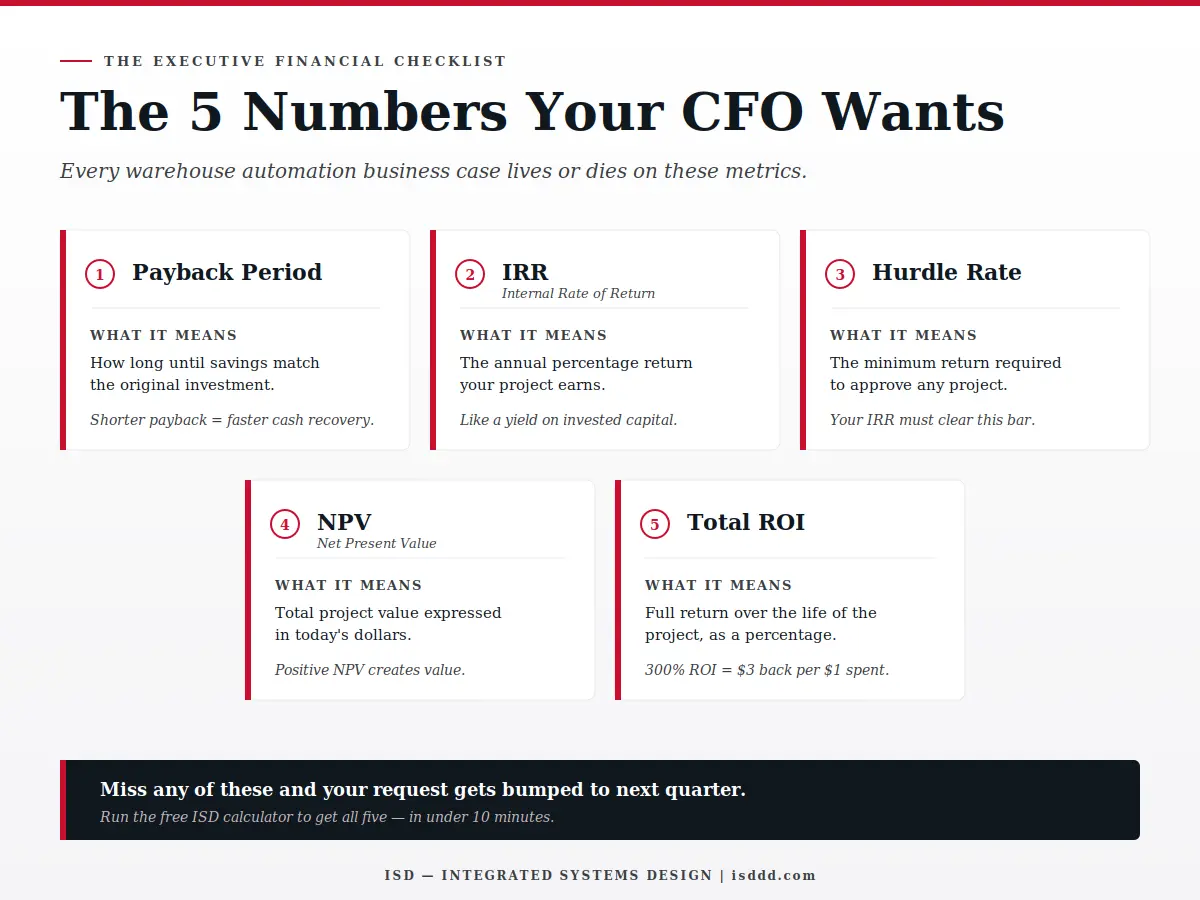
Your CFO evaluates capital requests against five warehouse automation IRR metrics. Know them before you walk in.
Payback period. How long until the project pays for itself? A 3-year payback means your cumulative savings will equal the investment by the third year. Shorter is better.
IRR (Internal Rate of Return). The annual percentage return your project earns, similar to a savings account yield. A 25% warehouse automation IRR means the project generates a 25% annual return on invested capital.
Hurdle rate. The minimum return your company requires to approve any capital project. It reflects the cost of capital plus a risk premium. If your hurdle rate is 15% and your project’s IRR is 25%, you clear the bar. If IRR falls below the hurdle rate, the project gets rejected — no matter how compelling the operational story.
NPV (Net Present Value). The total value of the project in today’s dollars. A dollar saved in year 5 is worth less than a dollar today, so NPV discounts future savings back to present value using the hurdle rate. Positive NPV creates value. Negative NPV destroys it.
Total ROI. The full return over the project’s life is expressed as a percentage of the original investment. A 300% total ROI means you get back $3 for every $1 spent.
If you miss any of these, your request will be postponed to the next quarter, next year, or possibly never.
Why Spreadsheets Miss the Real Story and You Need This Warehouse Automation ROI Calculator
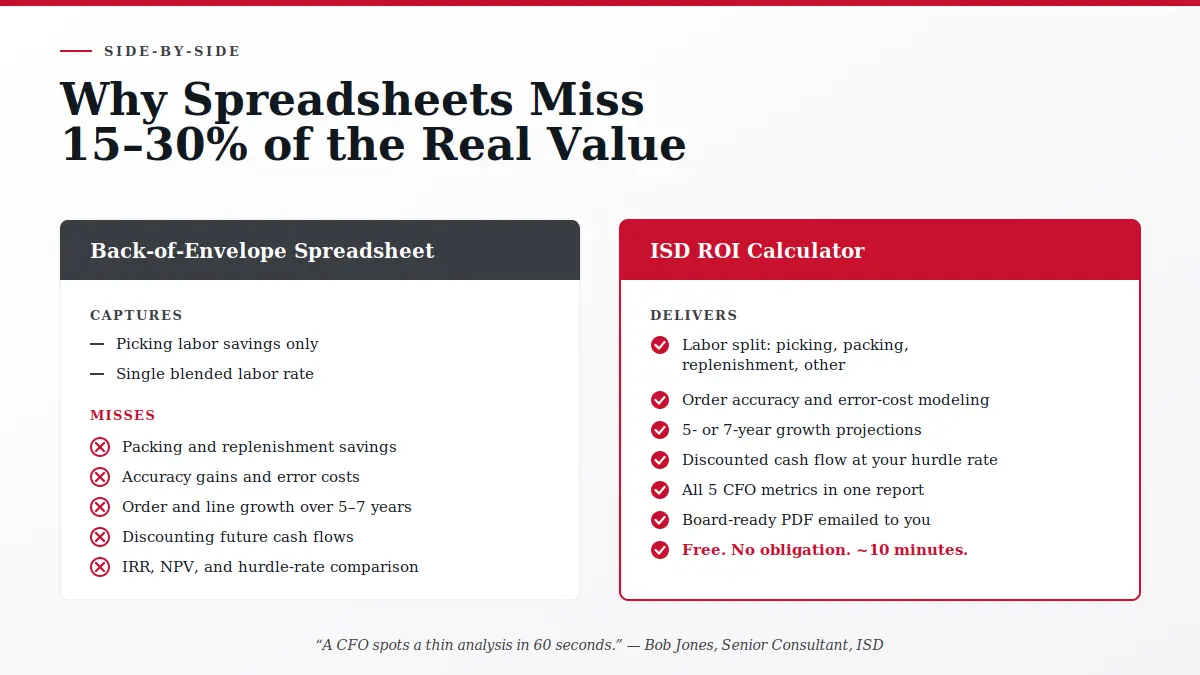
Most operations leaders build their first ROI pass in Excel. That’s a good starting point. It’s also where most projects quietly lose their margin.
Back-of-envelope spreadsheets usually model labor savings only. They ignore accuracy gains, error costs, replenishment labor, and growth in order volume. They apply a single blended labor rate, hiding where savings actually come from. They rarely discount future cash flows to present value.
The ISD Warehouse Automation ROI Calculator breaks labor into four functions — picking, packing, replenishing, and other — each with its own staff count, hourly rate, and throughput. It pulls order accuracy and cost per error into the model. It layers in order and line growth over five or seven years. It discounts future savings using your hurdle rate.
For illustration, picture a 200,000 sq ft facility running 5,000 orders a day with 40 pickers at $22 an hour. A 35% picking reduction saves roughly 14 FTEs. A simple spreadsheet stops there. The calculator also captures packing and replenishment savings, accuracy gains, and five years of order growth — often turning a borderline payback into a clear approval.
“When a customer hands me a napkin-math ROI, I usually find 15 to 30 percent of the real value missing,” Jones said. “It’s not their fault — they don’t have the model. But a CFO spots a thin analysis in 60 seconds. This Warehouse Automation ROI Calculator builds the analysis your finance team would build if they had time.”
What You Need to Run the Warehouse Automation ROI Calculator in 10 Minutes
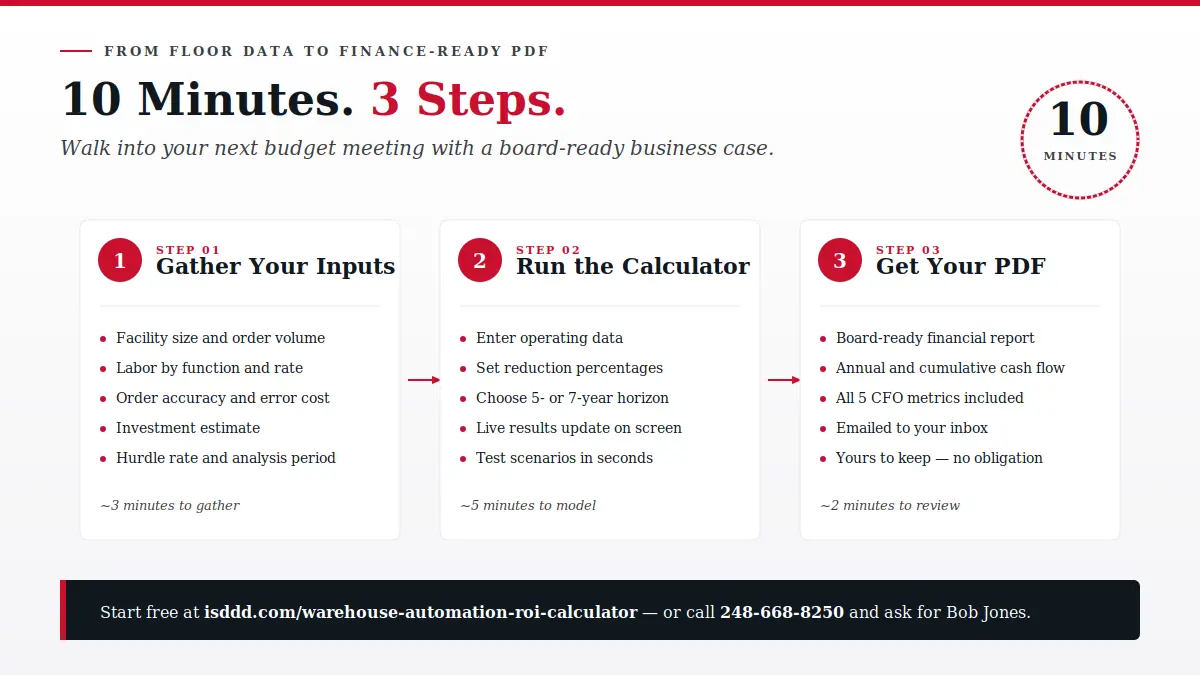
Before you start, gather:
- Facility basics: size, daily orders, daily lines, and order/line growth rates
- Labor by function: staff count, fully-loaded hourly rate, and throughput for picking, packing, replenishment, and other
- Current accuracy: order accuracy percentage and cost per error
- Investment estimate: equipment, installation, facility modifications, training, and a contingency percentage
- Expected reductions: typical ranges are 20–50% picking, 15–35% packing, 10–30% replenishment, and 5–20% other
- Finance inputs: analysis period (5 or 7 years) and your hurdle rate
Not sure about your reduction percentages? Run four scenarios: expected, conservative, aggressive, and flat growth. If IRR stays above your hurdle rate in the conservative case, you have a solid project.
The Warehouse Automation ROI Calculator inputs stay with ISD for internal reference only. We don’t share or sell your data, so you can enter real operating numbers with confidence.
When to Skip the DIY and Reach Out to ISD for Help
The Warehouse Automation ROI Calculator is free, and the PDF is yours whether you move forward or not. It’s also a starting point. Three situations deserve a human walkthrough.
You’re running a multi-technology project, ASRS plus robotics plus WMS, for example. The interactions between systems affect the percentage of change in ways the calculator can’t model alone.
You’re justifying more than $5 million. A 15-minute analysis is accurate enough to decide whether to invest the time in a comprehensive study, but not accurate enough for final board approval at that investment level. Finance wants sensitivity analysis, risk scenarios, and a sourced benefits breakdown. Bob helps deliver that comprehensive review.
You’re not sure where to start. Bob runs ISD’s consultative process using the OptimalOps-Process™ framework. He’ll show you which function delivers fastest payback and which to sequence later.
“The calculator provides you a defensible number. A conversation gives you a defensible strategy,” Jones said. “Spend 10 minutes on the Warehouse Automation ROI Calculator. Then spend 30 minutes with me. That combination has won more automation budgets than any other approach we use at ISD.”
One Big Number the Calculator Leaves Out: Space Savings
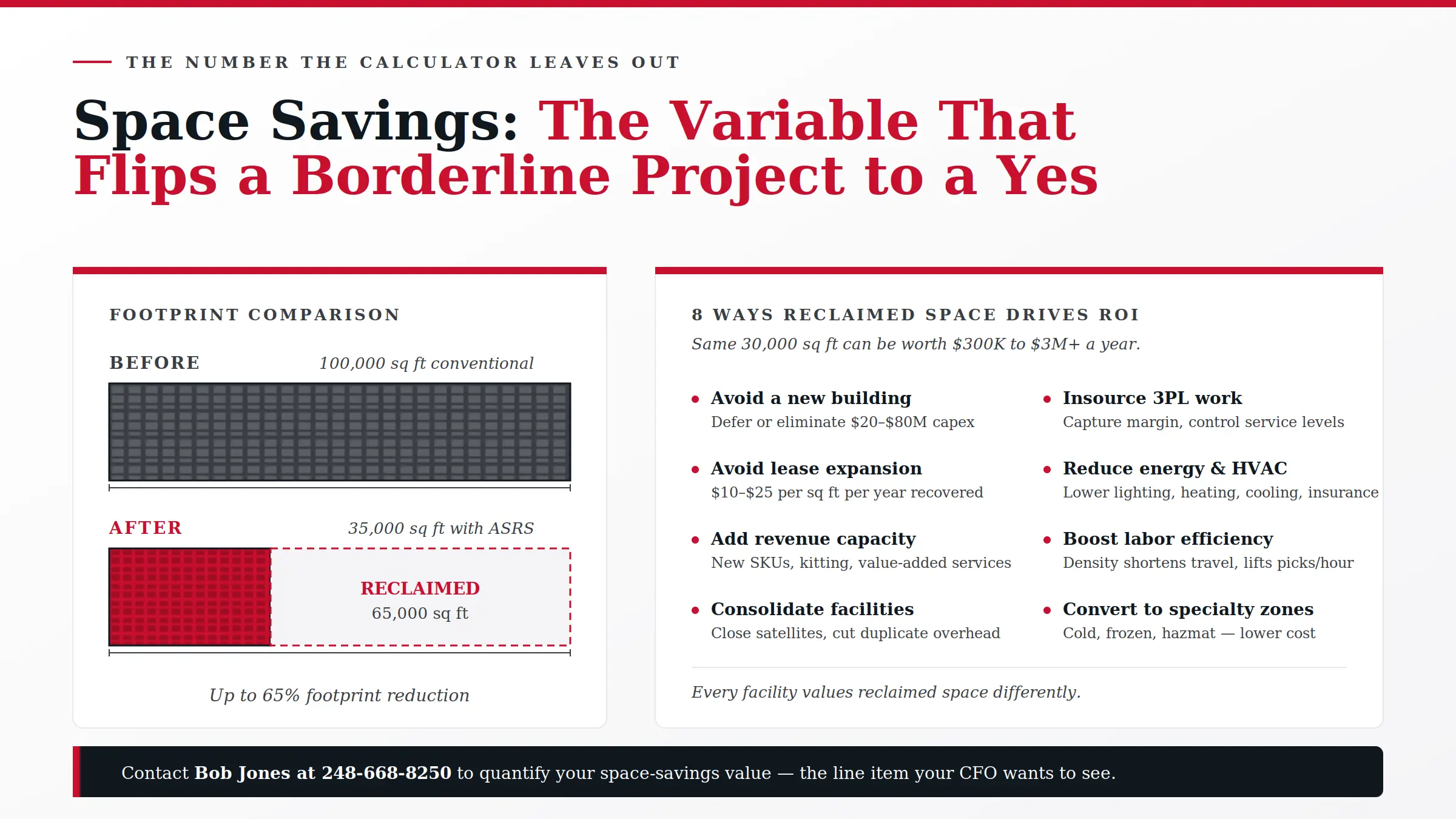 You’ll notice the calculator doesn’t include space savings. That’s deliberate. The math itself is simple — multiply square footage recovered by your cost per square foot. The value of that recovered space is anything but simple, and it varies wildly from one facility to the next.
The same 30,000 square feet of recovered floor space might be worth $300,000 a year to one operation and $3 million to another. It depends entirely on what you do with it.
Here are the ways space savings can dramatically reshape your ROI, IRR, and NPV:
- Avoid a new building. Recovering 25–40% of your warehouse footprint can defer or eliminate a $20–$80 million capital project. That single line item often dwarfs every other automation benefit combined.
- Avoid a lease expansion. Industrial rents in many U.S. markets now run $10–$25 per square foot per year. Reclaiming 50,000 square feet can mean $500,000 to $1.25 million in annual lease savings.
- Add revenue-generating capacity. Reclaimed space can host new SKUs, new product lines, value-added services, kitting, light assembly, or e-commerce fulfillment, each generating margin the old footprint couldn’t.
- Consolidate multiple facilities. Higher storage density lets you close satellite warehouses, eliminating duplicate rent, utilities, management overhead, and inter-facility transportation costs.
- Insource what you outsource. Recovered space can bring 3PL or co-packer work back in-house, capturing margin and improving service-level control.
- Reduce energy and HVAC costs. Smaller active footprint means lower lighting, heating, cooling, and insurance costs, ongoing savings that compound over the project’s life.
- Improve labor efficiency through density. Compact, high-density storage shortens travel distances. That means more picks per hour and fewer FTEs needed to hit throughput targets.
- Free space for cold or specialty zones. If your business is growing in refrigerated, frozen, hazmat, or controlled-environment storage, space recovered through automation can convert to high-value specialty square footage at a fraction of new-build cost.
“Space savings is the variable that flips a borderline project into an obvious yes,” Jones said. “We’ve seen ASRS deployments where labor savings pay for the system in four years, and the avoided new-building cost pays for it in eighteen months. We avoid putting space savings in the Warehouse Automation ROI Calculator because we prefer to quantify it correctly with you rather than incorrectly in an automated calculator.
If your facility is anywhere near capacity or already paying for overflow, contact ISD to walk through your specific space-saving value. We’ll help you build the line item your CFO wants to see.
Run the Numbers. Then, call or email ISD, and we will walk you through the process.
Start your analysis now at isddd.com/warehouse-automation-roi-calculator. Just fill in your data and see your warehouse automation IRR. The Warehouse Automation ROI Calculator is free. The PDF arrives in your inbox, and you can re-run scenarios anytime.
When you’re ready to pressure-test the results and build a full, board-ready business case, contact ISD’s Bob Jones, Senior Consultant at ISD. Bob Jones and the ISD team use the OptimalOps-Process framework to refine your numbers, stress-test assumptions, and map the sequence of investments that will deliver the fastest payback. Call 248-668-8250 or email information@isddd.com and ask for Bob Jones.