There’s no single best robot for palletizing. The right choice depends on your speed, payload, reach, and product mix. End-of-arm tooling matters just as much as the robot itself. If you get either one wrong, the other cannot compensate for it. Choosing among the different palletizing robot types is the first real decision in any automation project.
On This Page:
Palletizing Robot Types Compared
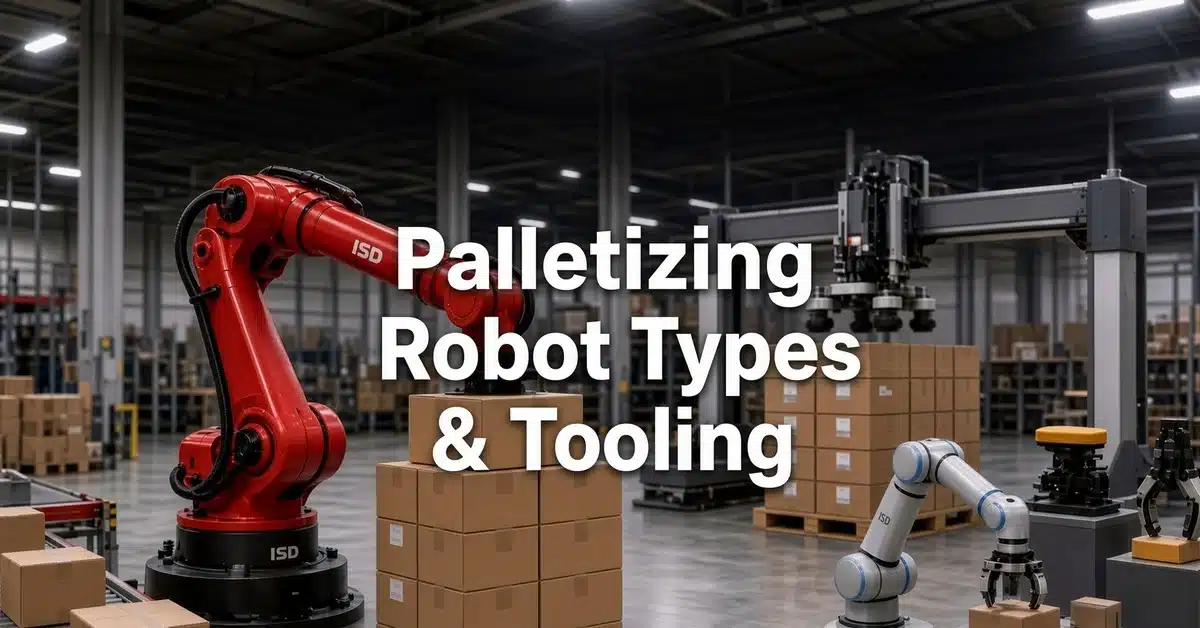
Four palletizing robot types cover most palletizing and de-palletizing applications. Each suits a different combination of speed, payload, and floor plan.
Collaborative robots, often called cobot palletizers, work near people without full safety fencing. That makes them a fit for tight spaces or lower-volume lines. A cobot palletizer trades some speed and payload for that flexibility. Cobot palletizing tends to suit operations that don’t need maximum throughput.
Industrial six-axis robots handle higher speeds and heavier payloads than collaborative arms. They’re the most common choice for high-volume, single- or mixed-SKU palletizing lines. These cells fall under industrial robot safety standards from the Association for Advancing Automation, which require full guarding.
SCARA robots move fast within a fixed vertical plane. They fit well where product arrives in a consistent orientation and speed matters more than reach or flexibility.
Gantry-style systems span wide conveyor lines and handle layer or full-pallet moves. They suit applications with multiple lanes or very wide infeed that a floor-mounted arm can’t reach efficiently. MHI’s Robotics Group notes that matching robot geometry to the application is one of the most common early-stage gaps.
| Robot Type | Best Fit | Tradeoff |
|---|---|---|
| Collaborative (Cobot) | Tight spaces, lower volume, near-worker operation | Lower speed and payload |
| Industrial six-axis | High-volume, single- or mixed-SKU lines | Requires full safety guarding |
| SCARA | Consistent product orientation, high speed | Limited reach and flexibility |
| Gantry | Wide conveyor lines, multiple lanes | Larger footprint and installation cost |
End-of-Arm Tooling Options
End-of-arm tooling has to match your product, not just your robot.
- Vacuum tooling suits cases and cartons with flat, sealable surfaces, and it’s the most common choice for corrugated case palletizing.
- Mechanical clamps handle bags, irregular shapes, or products that won’t hold a vacuum seal. That includes many bagged goods and some totes.
- Bag grippers are purpose-built for powders, feed, and other bulk bagged product where a standard clamp would damage the bag.
- Combination tooling pairs vacuum and mechanical grip in one head. It suits mixed-SKU lines that handle both cases and bags without a tooling changeover.
Matching Robot and Tooling to Your Product
Robots and tooling are a paired decision, not two separate ones. A high-speed industrial robot with the wrong gripper still bottlenecks at the pick point. A well-matched gripper on an undersized robot still can’t hit your cycle rate target.
“We see people fall in love with a robot spec sheet before they’ve nailed down the tooling. The gripper is what actually touches your product, and if it’s wrong for even one SKU in your mix, that SKU becomes a manual exception on an automated line.”
Common Mistakes in Robot and Tooling Selection
A few mistakes show up often when narrowing down palletizing robot types and tooling. Sizing the robot to average volume instead of peak volume leaves it short during your busiest weeks. Choosing tooling before mapping the full SKU range means surprises when a new product doesn’t fit the gripper. Ignoring the environment, such as cold storage or washdown requirements, can shorten equipment life or force a costly retrofit.
“The spec sheet always looks fine in a quiet showroom. What matters is whether the robot and tooling hold up at your actual peak rate, with your actual product mix, in your actual environment. That’s where a real evaluation earns its keep.”
Where This Fits in Your Project
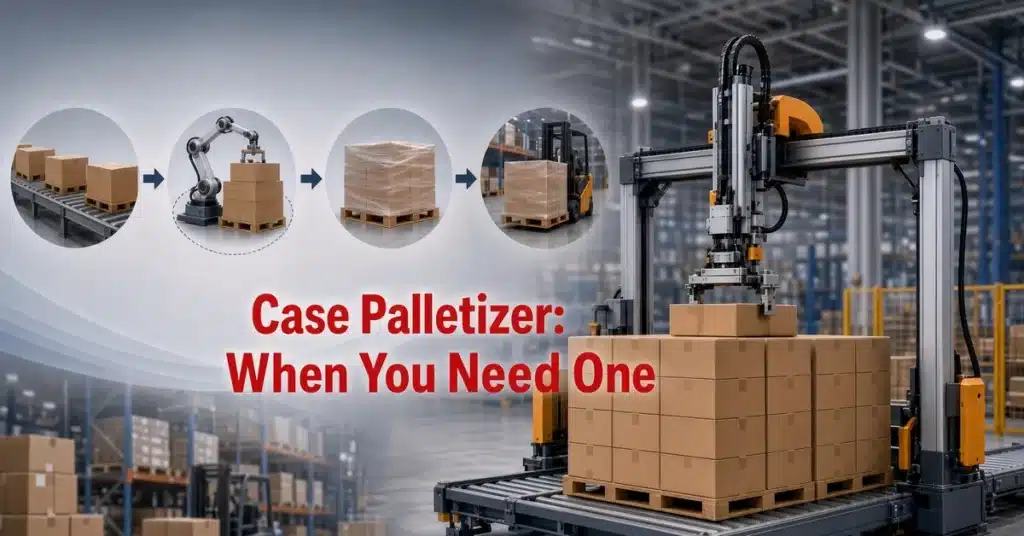
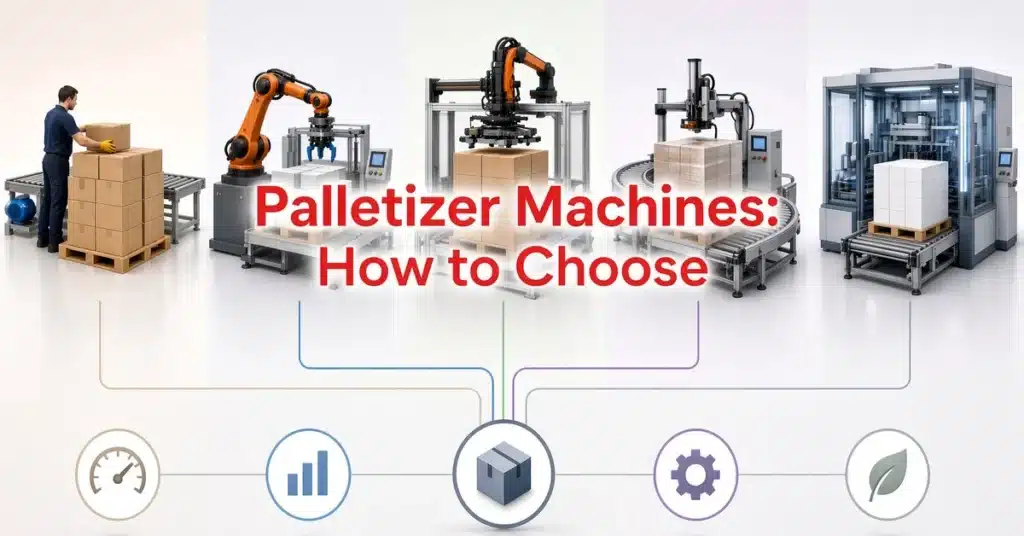
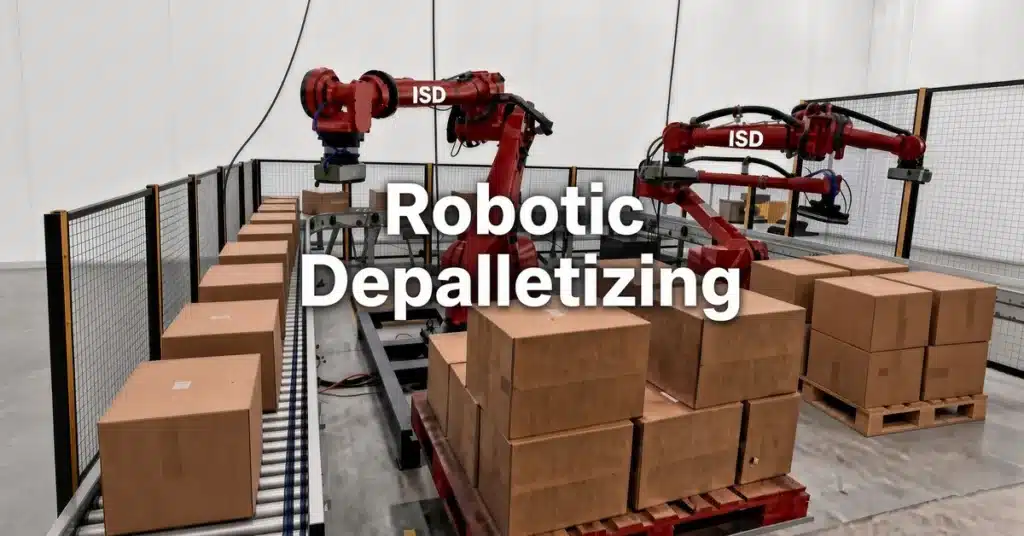
Robot and tooling selection is one piece of a larger palletizing or de-palletizing project. Our Palletizing Module page covers the full picture. The de-palletizing deep dive looks at how the reverse process changes the equation. If you’re still deciding whether the timing is right, our readiness guide can help. The end-of-line automation guide covers what surrounds the robot itself. The types of palletizer machines guide compares equipment at a broader level. For cartons and boxes specifically, see the case palletizer guide.
“Robot and tooling selection is where a lot of projects go sideways, because it’s tempting to lock in equipment before the product data is complete. We’d rather spend an extra week confirming SKU ranges than deliver a system that stalls on the SKUs nobody mentioned.”
Our Is This a Good Palletizing Application? checklist is a fast way to see where your operation stands before that conversation. Getting palletizing robot types and tooling right up front saves rework later.
Frequently Asked Questions
What robot type is fastest for palletizing?
SCARA and industrial six-axis robots generally offer the highest speeds. The right choice still depends on your payload, reach, and floor plan, not speed alone.
Can one gripper handle both cases and bags?
Combination tooling can handle both in some applications, pairing vacuum and mechanical grip in one head. Whether it fits your line depends on your specific product mix and cycle rate.
Do collaborative robots work for high-volume palletizing?
Sometimes, but a cobot palletizer generally trades speed and payload for reduced guarding needs. High-volume lines more often use industrial six-axis or gantry systems.
How do I know which tooling fits my product?
ISD reviews product samples, dimensions, and packaging type during a consultation. That review recommends tooling that fits your full SKU range, not just your primary product.
About ISD
ISD is a systems integrator specializing in warehouse, distribution, and manufacturing operations. ISD is also an OEM provider of the UltraStore Mid-Load ASRS system. ISD’s proprietary OptimalOps-Process uses an 8-step framework to improve operational efficiency and reduce costs. It also speeds up ROI across picking, sorting, packing, and shipping.
ISD works closely with clients to define objectives, analyze data, and build tailored solutions. Our offerings span conveyor systems, ASRS, AMRs, robotics, sortation, warehouse software, pallet handling, packaging automation, and order fulfillment technologies. Learn more at www.isddd.com.
Ready to Talk Through the Right Robot and Tooling for Your Product?
Schedule a consultation with ISD, or see the full Palletizing Module page for the bigger picture.