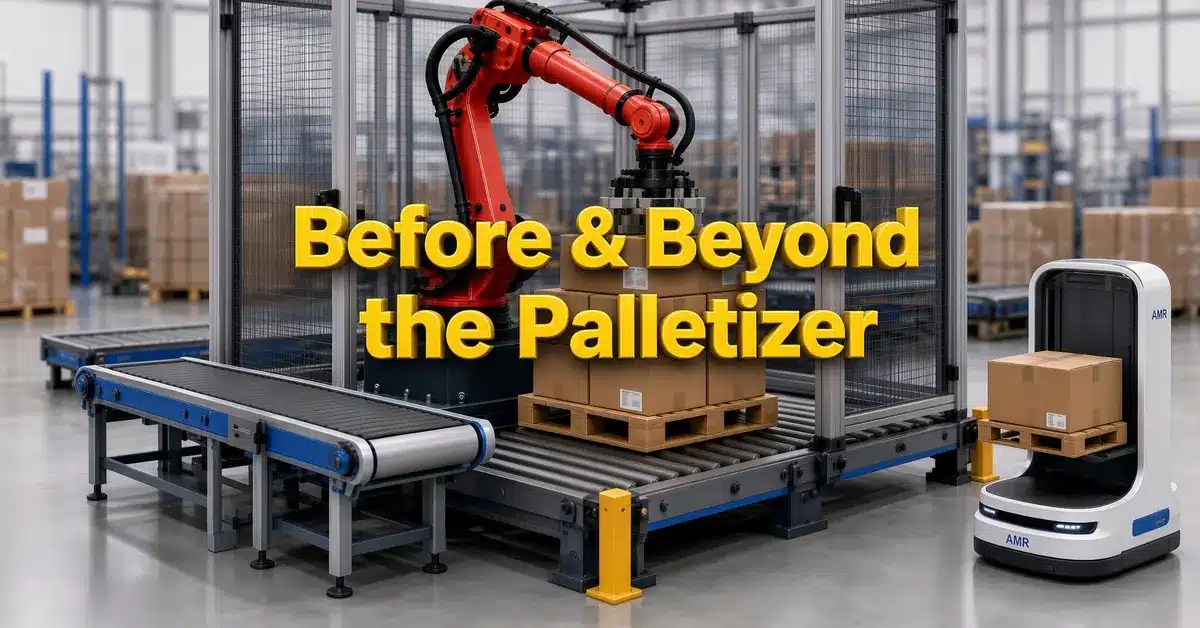
End-of-line automation is everything that surrounds the palletizing robot itself. That includes the equipment feeding cases into the cell and the equipment moving finished pallets out. A palletizer alone rarely solves the whole problem. Real end of line palletizing usually comes from the stations before and after it, not the robot alone.
On This Page:
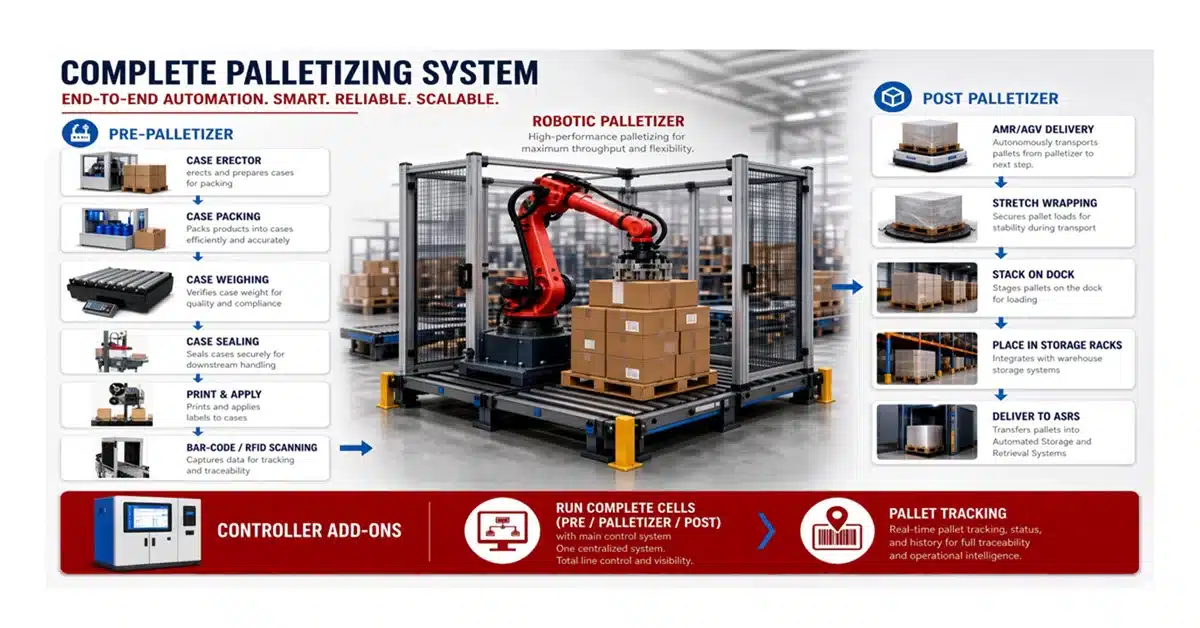
Pre-Palletizer: Preparing Product for the Cell
Product needs preparation before it ever reaches the robot.
- Case Erector: forms and prepares cases for packing
- Case Packing: loads product into cases efficiently and accurately
- Case Weighing: verifies case weight for quality and compliance
- Case Sealing: seals cases securely for downstream handling
- Print and Apply: prints and applies labels to cases
- Barcode / RFID Scanning: captures data for tracking and traceability
Together, these stations turn loose product into a case the palletizer can actually pick up. Skipping any one of them usually pushes that work back onto a person standing at the infeed. The Packaging Machinery Manufacturers Institute maintains standards for exactly this kind of case erecting and sealing equipment.
Post-Palletizer: Getting the Pallet to Its Next Stop
Getting a finished pallet off the palletizer is only the start of the next leg.
- AMR / AGV Delivery: autonomously transports pallets from the palletizer to the next step
- Stretch Wrapping: secures pallet loads for stability during transport
- Stack on Dock: stages pallets on the dock for loading
- Place in Storage Racks: integrates with existing warehouse storage systems
- Deliver to ASRS: transfers pallets into automated storage and retrieval
Stretch wrapping in particular matters more than it looks. The International Safe Transit Association publishes test standards for exactly this kind of unit-load stability. A poorly wrapped pallet can fail in transit even when everything upstream was done correctly.
Delivering into an ASRS is worth calling out on its own. It turns a palletized load into inventory the system can retrieve automatically, without another manual handoff.
Controller Add-Ons: Running It as One System
None of these stations does much good running in isolation. The real value shows up when pre-palletizer, palletizer, and post-palletizer all run under one main control system. That beats three disconnected point solutions every time.
“Clients often buy the pieces one at a time, a case sealer here, a stretch wrapper there. The system only gets efficient once everything reports to one controller. That’s when you get real pallet tracking and real visibility into the whole line, not just the robot in the middle of it.”
Pallet tracking is the other half of this. Real-time status and history on every pallet gives you traceability. That data is something you simply don’t get from a standalone cell.
The Next Step: Truck Loading and Unloading
The pallet’s next stop after storage or staging is usually a truck. Automated and semi-automated truck loading and unloading extends this same end-of-line automation logic to the dock door. That is where the pallets this cell builds eventually leave the building.
“Everything we’ve talked about here, case prep, palletizing, storage, ends at a dock door eventually. Truck loading is the natural next automation conversation once the rest of the line is solid.”
See ISD’s existing automated truck loading and unloading system page for more on that technology. A dedicated content cluster on truck loading and unloading is coming soon.
Where This Fits in the Palletizing Cluster
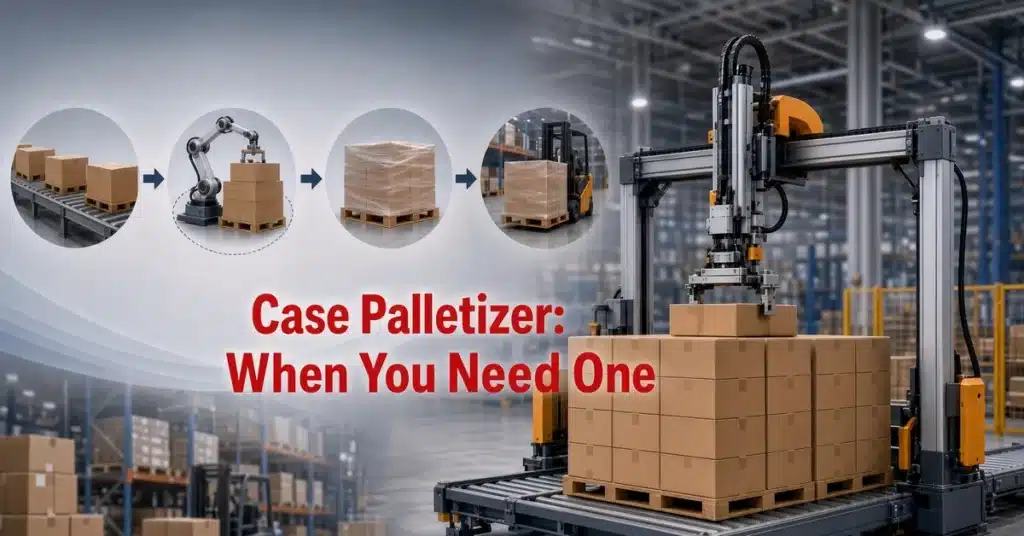
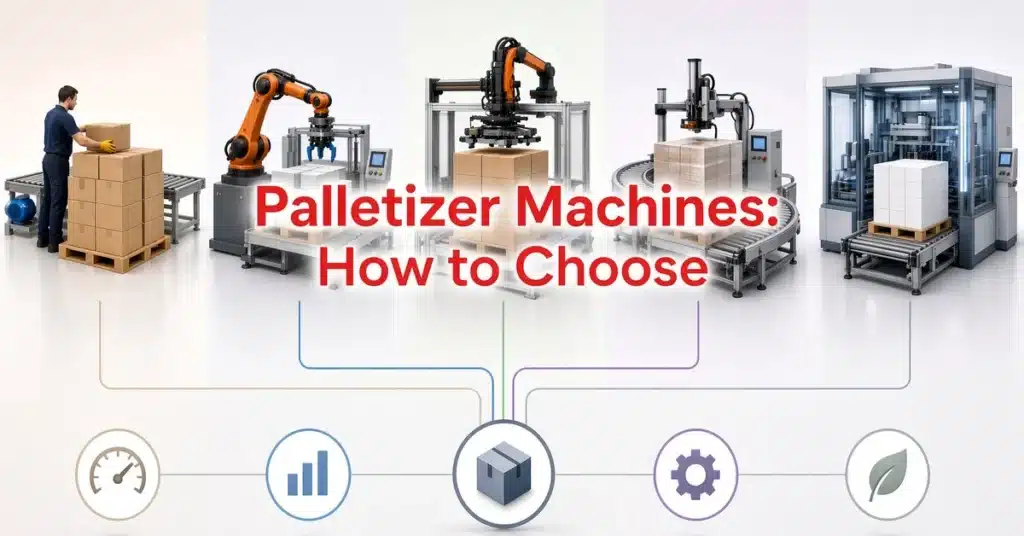
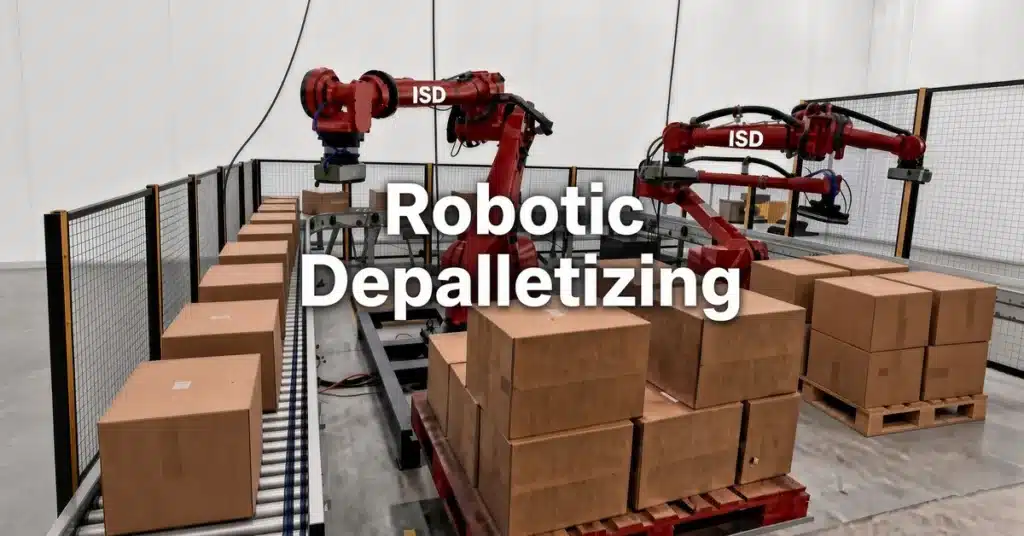
This page ties together the rest of the palletizing cluster and the end-of-line automation story around it. Our Palletizing Module page covers the robot itself, and our robot and tooling guide covers matching equipment to product. The reverse process, on the receiving side, is covered in our de-palletizing deep dive. Still comparing equipment types? The types of palletizer machines guide covers the broader category, and the case palletizer guide covers cartons and boxes.
“We rarely design a palletizing cell in isolation anymore. Clients want to know what happens to the case before it gets there and what happens to the pallet after it leaves. That’s the whole line, not just one machine, and treating it that way from the start avoids a lot of rework later.”
Our readiness guide and our Is This a Good Palletizing Application? checklist are both good next steps if you are still scoping the project.
Frequently Asked Questions
What counts as end-of-line automation beyond the palletizer?
Everything feeding the cell and everything moving product out of it. That includes case erecting, sealing, and labeling before the robot, and stretch wrapping, storage, and ASRS delivery after it.
Do I need all of these stations, or just the palletizer?
It depends on your current process. Some facilities only need the robot. Others get more value from automating the stations around it first.
Can these stations run under one control system?
Yes. ISD often designs pre-palletizer, palletizer, and post-palletizer equipment to report to one main controller. That is where pallet tracking and full-line visibility come from.
How does this connect to truck loading and unloading?
It is the natural next step after the pallet leaves storage or staging. ISD’s existing truck loading and unloading page covers that technology, with more content on the way.
Where should I start if I am scoping a full line?
Start with the Palletizing Module page for the core technology. Then use the readiness guide and checklist to see where your operation stands today.
About ISD
ISD is a systems integrator specializing in warehouse, distribution, and manufacturing operations. ISD is also an OEM provider of the UltraStore Mid-Load ASRS system. ISD’s proprietary OptimalOps-Process uses an 8-step framework to improve operational efficiency and reduce costs. It also speeds up ROI across picking, sorting, packing, and shipping.
ISD works closely with clients to define objectives, analyze data, and build tailored solutions. We do not sell one station in isolation and call it end-of-line automation. Our offerings span conveyor systems, ASRS, AMRs, robotics, sortation, warehouse software, pallet handling, and order fulfillment technologies. Learn more at www.isddd.com.
Ready to Look at the Whole Line, Not Just the Palletizer?
Schedule a consultation with ISD, or see the full Palletizing Module page for the core technology.