By Ed Romaine, Vice President of Marketing
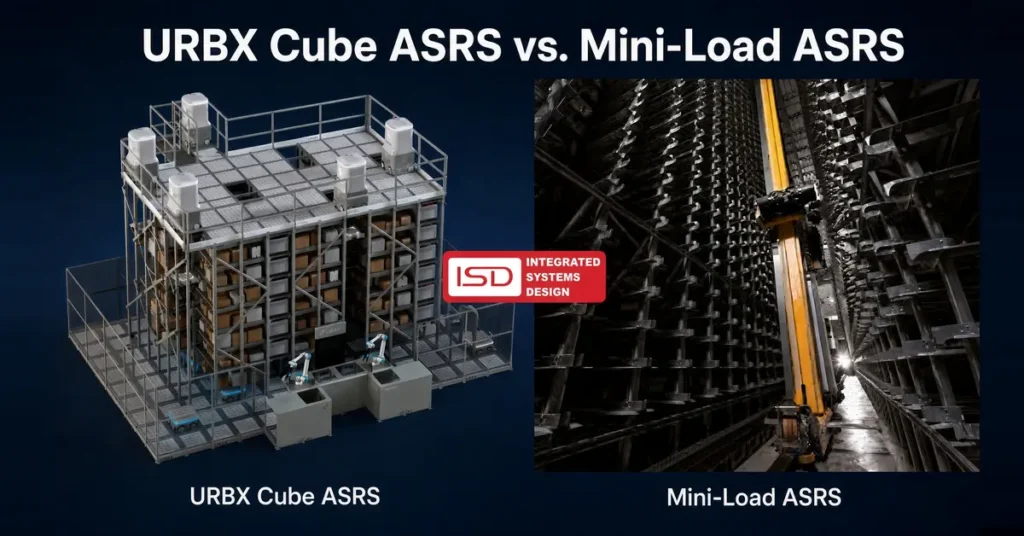
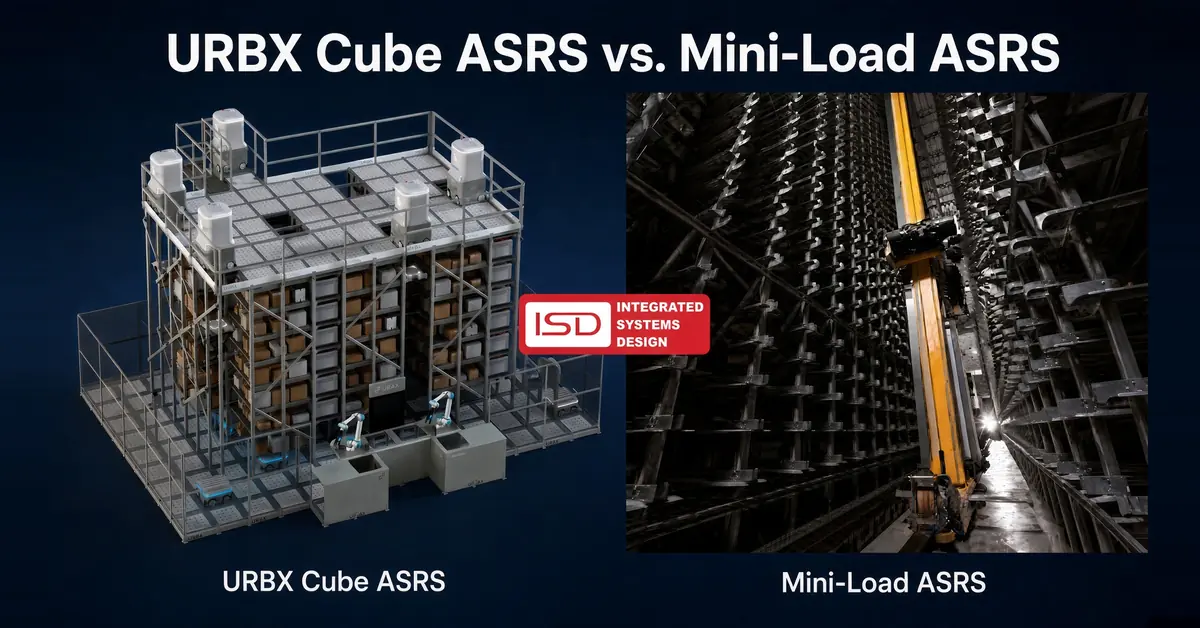
Mini-load vs. cube storage is a common question once buyers decide to automate tote storage. Both systems store totes densely and bring them to an operator. However, one works in aisles and the other works in a grid, and that difference shapes everything from height to how the system grows.
At ISD, we build the UltraStore Mini-Load ASRS, represent several other OEMs’ mini-load models and integrate the URBX AI-Cube ASRS, along with many other technologies. So we don’t have a horse in this race. We’re OEM agnostic, so let’s compare them fairly.
What Is a Mini-Load ASRS?
A Mini-Load ASRS stores totes, bins or cartons in aisles of racking. A crane or robot travels each aisle, picks up a tote and delivers it to a pick station at the end of the aisle. After the pick, it puts the tote away again.
Because each aisle has its own crane, throughput depends on how many aisles you build and how fast each crane cycles. That makes a Mini-Load predictable and easy to size when demand is steady. It also means more volume usually calls for more aisles.
Our UltraStore Mini-Load runs from 20 to 50 feet tall and handles totes up to 55 lbs. It uses standard warehouse racking, rides on the floor with no embedded rail and uses off-the-shelf parts. A typical system holds 500 to 5,000 or more tote positions in 500 to 5,000 square feet. For how it compares with a larger crane system, read Mid-Load vs. Mini-Load ASRS.
What Is Cube Storage?
Cube storage packs loads into a 3D grid instead of aisles. In the URBX AI-Cube ASRS, TowerBots travel across the top of the grid and retrieve loads through vertical shafts. GridBots and conveyor then carry them to workstations.
URBX stores totes, native cases or both, up to 100 lbs., in grids from 20 to 125 feet tall. It has direct access to every storage location, with no digging through stacks. For the basics, read What Is Cube Storage ASRS?
Mini-Load vs. Cube Storage: Side by Side
| Mini-Load ASRS (UltraStore) | URBX AI-Cube ASRS | |
|---|---|---|
| Layout | Aisles of standard racking, with a crane or robot in each aisle | A 3D grid with no aisles inside it; robots on top and below |
| Height | 20 to 50 feet | 20 to 125 feet |
| Loads | Totes up to 55 lbs. | Totes, native cases or both, up to 100 lbs., including irregular size loads |
| Floor | Rides on the floor, with no embedded rail | Forgiving floor flatness requirements |
| How throughput grows | Add aisles and cranes; each aisle’s crane sets its pace | Add robots and workstations; sized by simulation |
| Typical scale | 500 to 5,000+ tote positions in 500 to 5,000 sq. ft. | Large SKU counts in one grid, from a modest footprint up |
| Best known for | Compact small-parts storage, spare parts and kitting | Picking, case handling or both at high density |
Neither column wins every row. In other words, the right choice depends on what you store, how much of it and the building you have.
Where a Mini-Load ASRS Fits Best
A Mini-Load is proven and simple, and it’s often the right call. For example, it tends to fit when:
- You store small parts in light totes. Spare parts, WIP components, electronics, medical devices and kitting are classic examples.
- Your SKU count is in the hundreds or low thousands, with steady demand.
- Your clear height is moderate. A Mini-Load uses 20 to 50 feet well.
- You want a compact first step. A smaller system can automate one department or one product family.
- You value standard parts. Standard racking and off-the-shelf components keep maintenance simple.
“A Mini-Load is a great machine for the right job. If you’ve got thousands of small parts in light totes, a modest ceiling and steady demand, it’s simple, proven and easy to maintain with standard parts. I’d rather put a customer in the right-size system than the biggest one,” said Robert Jones, Senior Consultant, ISD.
Where URBX Fits Best
URBX tends to pull ahead when the job gets bigger or more varied. For example:
- You have heavier loads or full cases. URBX handles up to 100 lbs. and stores native cases with no trays or carriers. We cover that in Automated Case Handling.
- You have height to use. Grids run up to 125 feet, so a tall building stores far more in the same footprint.
- Your SKU count is large. Thousands of SKUs fit in one dense grid without adding aisles.
- You need picking and case handling together. One URBX grid can do both.
- You expect to grow. Throughput scales by adding robots and workstations inside the same grid.
“Where URBX pulls ahead is the mix. Once a customer has heavier loads, full cases or a building with real height, an aisle-based system keeps adding aisles to keep up. URBX adds robots and workstations instead, inside the same grid. That’s usually when the math tips toward cube storage,” said Ryan Morgott, Systems Engineering Consultant, ISD.
Can You Use Both?
Yes, and sometimes that’s the best design. A Mini-Load can serve small parts near a production line, while URBX handles cases and higher volumes elsewhere in the building. Likewise, a Mini-Load can automate one area first, with URBX added as volume grows. Both connect to the same WMS or WES, so the software sees one operation.
“We build the UltraStore Mini-Load ourselves, and we integrate URBX. So we have no reason to push one over the other. Some of the best designs use both: a Mini-Load for small parts near the line and URBX for cases and higher volumes. The data decides, and our job is to show you that data,” said Tony Morgott, President, ISD.
URBX vs. Mini-Load: How to Decide
So how do you choose? Start with your data, not a brochure. Gather six things first:
- Load profile: Tote and case sizes, weights and how many SKUs you store.
- Order profile: Lines per hour at peak, order size and how often each SKU moves.
- Building: Clear height, floor condition and the space you can give the system.
- Growth: Where volume and SKU count are headed over the next five years.
- Uptime: How each design keeps running when a crane or robot is down for service.
- Spare parts and service: Which spare parts are available, where they come from and how quickly the equipment can be serviced.
Then simulate both against the same orders. Our OptimalOps-Process™ does exactly that before equipment is specified. For a full checklist, see How to Choose an ASRS, and for budgeting, our ASRS cost guide. If you’re weighing aisle-based shuttles too, read URBX vs. Shuttle Systems. For vendor-neutral background, MHI’s ASRS Industry Group is a good resource. Full disclosure: I serve as the group’s vice chair.
Mini-Load vs. Cube Storage: Questions and Answers
What is a Mini-Load ASRS?
A Mini-Load ASRS stores totes, bins or cartons in aisles of racking. A crane or robot in each aisle retrieves totes and delivers them to a pick station. ISD’s UltraStore Mini-Load runs from 20 to 50 feet tall and handles totes up to 55 lbs.
Is URBX a mini-load system?
No. URBX is a cube storage system. Robots on top of a 3D grid retrieve loads through vertical shafts, and there are no aisles inside the grid. A Mini-Load ASRS uses a crane or robot traveling an aisle of racking.
Which is better for small parts, mini-load or cube storage?
It depends on volume and building. A Mini-Load often fits a few thousand small parts in light totes with moderate clear height. Cube storage often fits larger SKU counts, heavier loads, full cases and taller buildings.
How tall can a mini-load ASRS be compared with URBX?
ISD’s UltraStore Mini-Load runs from 20 to 50 feet tall. URBX grids run from 20 to 125 feet tall, so URBX can use more of a tall building’s height.
Can a mini-load ASRS and URBX work together?
Yes. A Mini-Load can handle small parts in one area while URBX handles cases and higher volumes in another. Both connect to the same WMS or WES. Simulation shows whether one system, the other or both fits best.
Get a Straight Answer on Mini-Load vs. Cube Storage
Send us your order profile, and our engineers will model a Mini-Load and URBX side by side for your building. Call 248-668-8250, email information@isddd.com or, better yet, schedule a consultation.