Most warehouse operators know what an ASRS is, but what is cube storage ASRS? Most warehouse operators know what an ASRS is. Far fewer understand what sets cube storage ASRS apart from every other automated storage technology on the market. That distinction matters. The system you choose determines your throughput ceiling, your labor model, and your ability to scale. To get it right, you need to understand exactly what cube storage ASRS is and how it operates.
What Is Cube Storage ASRS?
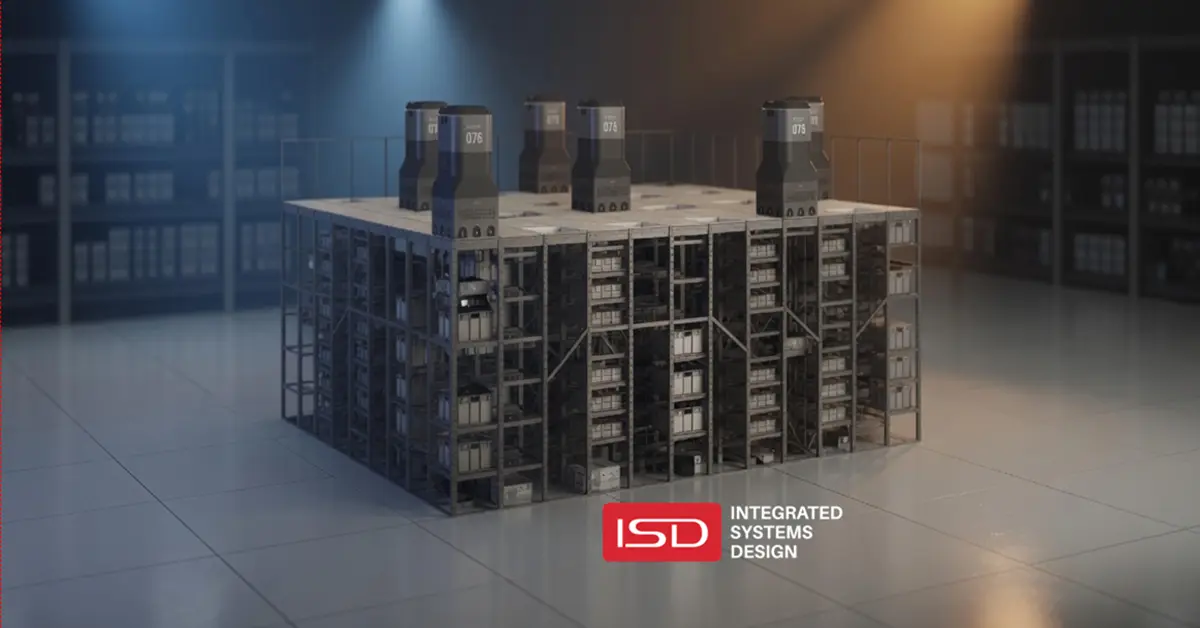
Cube storage ASRS is a three-dimensional automated storage and retrieval system that stores totes or cases in a dense, vertical grid structure. Robotic units navigate the top of that grid and retrieve totes or cases by descending through vertical shafts or chutes to the storage level where the tote or case resides. The robot extracts or places the tote or case from the rack and onto its base. Then the tote travels up and out to a conveyor or mobile robot, which delivers it to a pick workstation.
The word “cube” refers to the cubic architecture of the storage structure itself. Unlike a traditional ASRS, which uses cranes moving down single aisles, a cube storage system uses the full three-dimensional volume of the racking as an addressable grid. Every horizontal position and every vertical level is a storage position. Robots access any position through any available chute.
“The fundamental difference between cube storage and conventional ASRS is how inventory is accessed,” says Ed Romaine, VP of Marketing and Business Development at ISD. “In a traditional crane-based system, one machine owns one aisle. In a cube system, every robot can reach every tote or case. That changes the throughput math completely.”
ISD implements the URBX Cube Storage ASRS, a system engineered for high-density storage and high-speed goods-to-person fulfillment. URBX is the cube storage ASRS ISD utilizes for many operations that need maximum throughput density in a constrained footprint. Since there are multiple cube systems available, each one has its pros and cons and needs evaluating. ISD is an OEM-agnostic systems integrator that uses its OptimalOps-Process to evaluate each organization’s unique requirements and find the best solution.
How the URBX Cube Storage ASRS System Works
The URBX system has three layers: the storage grid, the TowerBot fleet, and the GridBot transport layer, which connects the grid to the pick workstations, conveyors, carts, or AMRs.
The storage grid is a high-density racking structure that holds totes in a double-deep, three-dimensional configuration. Standard systems can reach 20 to 125 feet in height. A single standard footprint of approximately 24,025 square feet holds 168,960 totes. Maximum configurations store 504,000 totes across 150 levels.
TowerBots are the retrieval robots. They travel across the top of the grid and descend into vertical shafts to access totes at any level. Each TowerBot presents more than 100 totes per hour, delivering at a 7-second average pick time. TowerBots operate at 26 feet per second. They can be added or removed as throughput requirements change, making the system genuinely scalable rather than just configurable.
The transport layer consists of GridBot robots and an integrated conveyor or AMR system. Once a TowerBot retrieves a tote, the GridBot or conveyor carries it to the workstation. The pick operator processes the order. The tote returns to storage automatically. For case handling, cases are buffered in the grid, then retrieved in the proper sequence and routed to palletizing or shipping.
An advanced AI Coordinator software manages the entire operation: task sequencing, robot routing, storage location optimization, and wave management. It integrates with your warehouse management system (WMS) or warehouse execution system (WES) using standard interfaces.
Is Cube Storage ASRS a Goods-to-Person System?
Yes. Cube storage ASRS is a goods-to-person (GTP) system. The inventory comes to the operator rather than the operator walking to the inventory. This is one of the key distinctions between cube storage and traditional pick-to-light or pick-to-pallet systems.
The goods-to-person model eliminates travel time, the single largest driver of labor cost in manual fulfillment. When operators stay at a fixed workstation and the system delivers totes on demand, throughput per operator increases dramatically. URBX delivers up to 500 lines per hour per operator, a benchmark that manual systems cannot match.
The GTP advantage compounds at scale. As order volume grows, you add TowerBots rather than adding headcount. The system absorbs volume spikes without hiring surges.
Can URBX Cube Storage Handle Cases?
Yes. The URBX system handles both totes and cases natively, without requiring cases to be put in totes or on carriers. This is one of the characteristics that distinguishes URBX from other cube storage platforms, which are typically optimized for tote-based piece picking only. The URBX system not only handles piece picking and case handling, but it can do it one system or orchestrated over multiple systems. This helps medium-sized applications to run efficiently and cost-effectively.
URBX accommodates tote heights from 5 inches to 60 inches and weight capacities up to 100 pounds per tote. Cases are stored and retrieved using the same grid architecture and TowerBot fleet as totes. The system can sequence cases for store replenishment, manufacturing lines, or shipping consolidation, kitting, and order fulfillment.
“The ability to handle cases alongside totes opens URBX to a wider range of applications,” says Bob Jones, Senior Distribution Consultant at ISD. “Food and beverage distributors, wholesale operations, and 3PLs handling mixed SKU profiles all benefit from that flexibility. You’re not forced to dedicate the system to one product format.”
Case handling also supports store replenishment workflows where full cases ship to retail locations while broken case (split case) picking continues at the same facility. URBX manages both concurrently.
Why URBX is a True Cube Storage ASRS System
URBX qualifies as cube storage because its architecture uses a cubic grid as the storage and retrieval medium. The racking creates a three-dimensional matrix of storage cells. Robots navigate that matrix in all three axes, selecting totes by their grid address rather than by aisle position.
The contrast with conventional ASRS technology is direct. A mini-load ASRS uses a crane in a single aisle. That crane is the only machine that can access inventory in that aisle (except for the UltraStore Mini-Load). If the other mini-loads fail, the aisle goes offline. In URBX, any TowerBot can reach any tote in the grid. There is no single point of failure tied to a specific storage location.
This architecture also enables vertical scalability that crane-based systems cannot match. URBX reaches up to 125 feet. It stacks totes or cases 75 or more levels high. The system grows vertically without expanding the floor footprint, a critical advantage in facilities where land cost or lease boundaries constrain horizontal expansion.
For a deeper comparison of ASRS technologies and how to select the right system for your operation, see ISD’s ASRS technology overview.
Where Cube Storage ASRS Fits: Industries and Applications
Cube storage ASRS performs at its highest value in operations with three characteristics: high SKU counts, high order velocity, and constrained floor space. When two or three of those conditions apply simultaneously, cube storage typically outperforms every alternative.
Ecommerce and omnichannel retail operations match this profile precisely. High SKU counts, tight ship-by windows, and labor constraints make the goods-to-person model and the throughput density of URBX a direct fit. Ecommerce operations often run 3,000 to 10,000 SKUs or more. URBX manages that depth without sacrificing speed.
3PL facilities benefit from URBX’s scalability and flexibility. A 3PL handling multiple clients with shifting volume profiles needs a system that adapts. TowerBot count adjusts with demand. Tote configurations accommodate different client inventory formats.
Food and beverage distributors use URBX for both tote-based piece picking and case sequencing. The system supports store replenishment runs where items must be sequenced by delivery stop. It also handles the mixed product formats common in food distribution.
Retail and wholesale operations deploy URBX to manage store replenishment at scale. The system sequences cases and totes by store, route, or delivery window. Labor savings in replenishment fulfillment typically range from 50 to 66 percent compared to manual processes.
For industry-specific applications across these sectors, ISD’s automation assessment process identifies where cube storage ASRS fits within your existing workflow.
Cube Storage ASRS vs. Other ASRS Technologies
Buyers evaluating cube storage ASRS often compare it against mini-load ASRS, mid-load ASRS, vertical lift modules, and horizontal carousels. Each technology has a legitimate use case. The decision hinges on throughput requirements, SKU profile, tote or load unit weight, and ceiling height.
The mini-load ASRS is a proven solution for tote and carton retrieval in aisle-based systems. It performs impressively in medium-throughput environments. The trade-off is single-aisle dependency and a lower throughput ceiling per aisle compared to cube storage.
The UltraStore Mid-Load ASRS handles heavier loads and larger containers than cube storage. It is the right choice when tote weight exceeds 100 pounds or when unit dimensions exceed cube storage tote specifications. Operations that mix light and heavy loads often use both systems in the same facility.
Vertical lift modules and horizontal carousels serve smaller footprint requirements and lower-throughput environments. They are appropriate for parts storage, kitting operations, or facilities where cube storage capacity would exceed actual demand.
Cube storage ASRS competes most directly with other cube storage platforms in the market. URBX differentiates itself on:
- Height capability (125 feet versus typical competitor maximums).
- Weight capacity (100 pounds per tote)
- Native case handling capability.
- The Made in USA manufacturing advantage reduces lead time and supports parts availability.
- Forgiving floor flatness. Other systems require critical levels of flatness, which can cost hundreds of thousands of dollars (and possibly a million).
“When we run the selection process through our OptimalOps-Process methodology, cube storage wins when throughput density is the primary driver,” notes Ed Romaine. “The system pays back faster when you’re running high volume through a constrained space. That’s a description of most modern distribution operations. The URBX system plays a critical role in implementing One-Touch distribution.”
What to Evaluate Before Selecting Cube Storage ASRS
A cube storage ASRS represents a significant capital investment. The evaluation process should address seven factors before you make a selection decision.
Ceiling height determines maximum system height and therefore maximum storage capacity. URBX reaches 125 feet, but your facility’s usable clear height drives the realistic configuration. Confirm structural capacity as well as clear height.
Throughput requirements drive TowerBot count. Model your peak day order volume, not your average. The system must handle the highest demand you will face, not the median.
SKU profiles shape tote configurations. Measure the range of product dimensions and weights in your inventory. Verify that tote sizes accommodate your product mix without excessive void fill or weight concentration issues.
WMS integration complexity affects implementation timeline. URBX integrates via standard protocols, but your current WMS and/or WES version, customizations, and data structure affect the integration scope. Plan for this early.
Floor load capacity must support the structural weight of the grid and stored inventory. URBX systems at full capacity carry significant concentrated loads. Please confirm the floor load ratings before the design begins.
Implementation timeline for URBX is typically 4 to 8 months depending on configuration complexity, integration scope, and site readiness. Budget time accordingly.
ROI modeling should be built on your actual labor rates, current order volume, projected growth, and facility cost. ISD’s Warehouse Automation ROI Calculator provides a starting point for that analysis.
Why ISD for URBX Cube Storage ASRS
ISD has implemented warehouse automation systems for more than 60 years. The company is vendor-agnostic across most technology categories, which means recommendations follow operational requirements rather than product margin or manufacturing availability.
For cube storage ASRS, ISD’s implementation of URBX begins with the OptimalOps-Process, a structured methodology that analyzes upstream and downstream workflow, not just the ASRS itself. The system design accounts for receiving, replenishment, pick station configuration, packing, and shipping integration. A cube storage system that is well-matched to adjacent processes delivers measurably better ROI than one that is installed without that context.
ISD’s aftermarket services division provides ongoing maintenance, parts, and optimization support after implementation. The system you install on day one is not the ceiling of what it can do. Continuous improvement after go-live drives a significant portion of the long-term return.
Ready to evaluate whether URBX cube storage ASRS is the right fit for your operation? Schedule a no-obligation consultation with ISD and bring your throughput requirements, facility data, and growth projections. The conversation takes 30 to 45 minutes. The output is a clear picture of whether cube storage belongs in your automation plan.
FAQ: Frequently Asked Questions – What Is Cube Storage ASRS?
What is cube storage ASRS?
Cube storage ASRS is a three-dimensional automated storage and retrieval system that stores totes in a dense vertical grid. Robots navigate the top of the grid and descend vertical shafts to retrieve totes, which are then delivered to pick workstations by conveyor or mobile robots.
Is cube storage ASRS better than other ASRS technologies?
Cube storage works best in high-throughput, high-SKU-count environments with constrained floor space. It is not universally superior. Operations with heavier loads, lower throughput requirements, or different SKU profiles may be better served by mini-load ASRS, mid-load ASRS, or vertical lift modules. The right technology will depend on your specific operational profile.
Is cube storage a goods-to-person system?
Yes. Cube storage ASRS is a goods-to-person system. Inventory is delivered to stationary pick workstations. Operators do not walk to inventory. This eliminates travel time and significantly increases the number of lines per operator per hour.
Can URBX cube storage handle cases?
Yes. URBX handles both totes and cases. Tote dimensions range from 5 to 60 inches in height, with weight capacity up to 100 pounds. This supports piece picking, case picking, and store replenishment sequencing within the same system.
Why is URBX considered cube storage?
URBX uses a cubic three-dimensional grid as its storage architecture. Robots access any storage location through any available vertical shaft. There is no single-aisle dependency. This is the defining characteristic of cube storage ASRS.
What industries benefit most from cube storage ASRS?
Ecommerce, 3PL, food and beverage, retail, and wholesale operations benefit most. These sectors share the combination of high order velocity, high SKU counts, and labor cost pressure that cube storage addresses most effectively.