By Ed Romaine, Vice President of Marketing
An automated case handling system stores, stages, buffers and sequences full cases without people walking, lifting or re-sorting them. For many distribution centers, that’s where the hidden labor lives. Pickers get the attention, but cases get touched again and again before they ever reach a pallet.
The URBX AI-Cube ASRS was built to change that. It stores native corrugated cases right in the grid, with no totes, trays or carriers. Then it releases them in the order your next process needs. As a result, one system can fill piece-pick orders, support automated pallet building, or both.
What Is an Automated Case Handling System?
An automated case handling system is equipment and software that moves full cases through storage and staging without manual handling. It receives cases, stores them, holds them as a buffer and releases them in sequence to picking, shipping or palletizing. The goal is simple: fewer touches, less walking and the right case at the right time.
Now think about how cases move in a typical building today. A forklift drops a pallet. Someone breaks it down. Cases get staged on the floor, moved again for a wave, then moved once more to build an outbound pallet. In other words, each case may be handled three or four times. Every one of those touches costs labor and floor space.
Why Native Cases Matter
Many cube storage systems were designed around bins. Bin-based systems such as AutoStore store products in standard bins stacked on top of each other. That works well for small items. However, cases must be opened and decanted into bins or totes before they can be stored. Either way, that means extra touches, steps and labor.
Decanting adds labor at receiving. It also adds bins, which you have to buy, clean and manage. Likewise, when a low bin is needed, robots have to move the bins above it out of the way.
URBX takes a different path. It stores cases as they arrive, with no totes, trays or carriers to load. Loads up to 100 lbs. go straight into the grid, including irregular size loads. Because loads sit in shafts with direct access, there’s no digging through stacks. When a rear load in a double-deep location is needed, URBX moves at most one tote or case to reach it.
“When a customer tells me they decant every case into a tote, I ask how many people and hours of labor that takes. Odds are, it’s more than they think. With URBX, we design around the case as it arrives. The product goes into storage in its own box, and that labor goes back into the operation,” said Ryan Morgott, Systems Engineering Consultant, ISD.
Store, Stage, Buffer and Sequence in One Grid
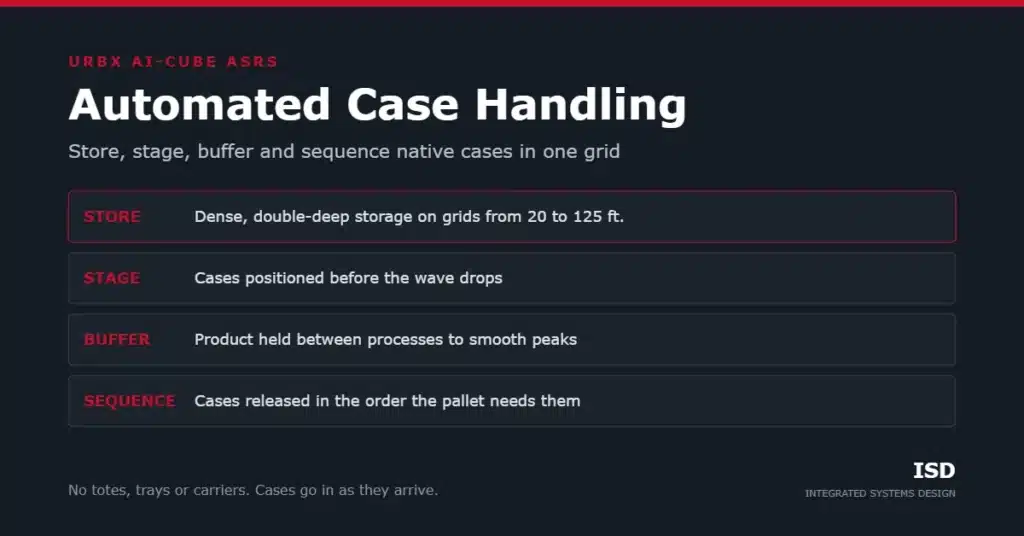
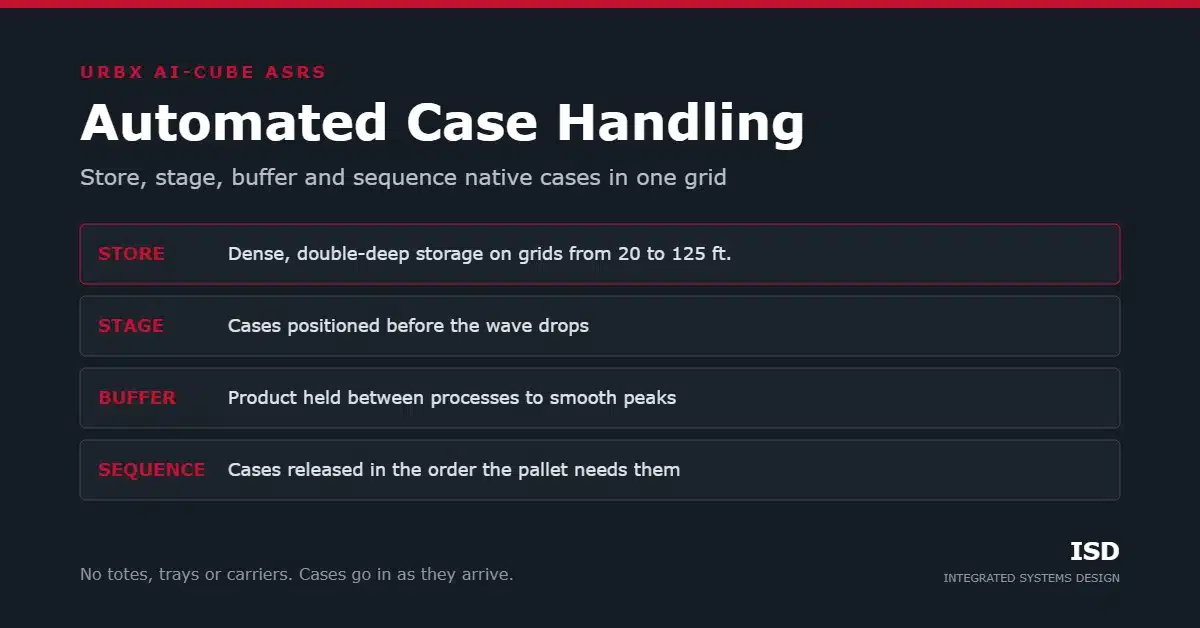
Case handling isn’t one job. It’s four, and URBX handles all of them in the same grid.
- Storing: Cases go into dense, double-deep storage on grids from 20 to 125 feet tall. Fast movers can sit in front positions, as assigned by the AI-driven software.
- Staging: Cases for the next wave are positioned ahead of time, so they’re ready when the order drops.
- Buffering: The grid holds product between processes. That helps smooth out peaks between receiving, picking and shipping.
- Sequencing: Cases release in the order a route, line or pallet needs them.
AI-driven software ties it together. It decides where each case goes and keeps the same item front to back where it can. It also repositions loads during slower periods. Each shaft keeps an open location or two for a fast hot swap when a rear load is needed.
“Slotting is where case handling is won or lost. We keep the same item front to back in a shaft whenever we can, and the software repositions loads during slower periods. So when the wave drops, the cases are already where they need to be. Nothing gets dug out of a stack. That’s how double-deep storage stays fast,” said Robert Jones, Senior Consultant, ISD.
From Grid to Pallet: How Case Handling Supports Automated Pallet Building
Here’s where case handling pays off downstream. A palletizer can only build a good mixed pallet if it gets the right cases in the right order. Heavy cases go on the bottom. Crushable cases go on top. Store or stop order matters, too.
Today, that sequencing is often done by hand. Someone stages cases on the floor, checks a list and feeds the line. As a result, the palletizer waits on people, and people wait on the palletizer.
URBX is designed to change that. Because the grid already stores, stages and sequences cases, it can release them in build order to an automated palletizing cell. In other words, case handling is what makes automated pallet building practical. ISD integrates URBX with conveyor and our robotic palletizing and depalletizing system to support mixed-case handling and palletizing in one flow.
The result can be store-ready mixed pallets with far fewer touches between storage and the dock. We introduced this approach in our cube ASRS case handling system announcement.
Picking and Case Handling in the Same System
Most buildings have both problems. They pick eaches for ecommerce or service orders, and they ship full cases for store replenishment. Traditionally, that means two systems: goods-to-person for picking and something else for cases.
URBX can run as a split-case picking system, a case handling system or both, in the same grid. Totes support piece picking at goods-to-person workstations. Native cases support storing, staging, buffering and palletizing. We treat piece-pick orders and store-ready mixed pallet orders as equal outputs, because for most of our customers they are.
“Most of the operations I walk through are running two businesses under one roof: eaches for ecommerce and full cases for the stores. They’ve usually been told that means two systems. With URBX, we can often design one grid that serves both. That changes the whole conversation about space, labor and budget,” said Ryan Morgott.
So instead of buying, installing and maintaining two systems, you can design one around your order profile. That can mean less equipment, less floor space and one software integration instead of two.
Where Automated Case Handling Fits
Automated case handling often pays off wherever full cases move in volume. For example:
- Food and beverage: Case-heavy orders, mixed pallets and tight delivery windows.
- Retail store replenishment: Store-ready pallets built in aisle or department order.
- Wholesale distribution: Large SKU counts with a mix of full cases and split cases.
- Third-party logistics: Several clients, several order profiles and one shared system.
- Manufacturing: Work in progress (WIP) stored and sequenced between production steps.
What to Know Before You Plan
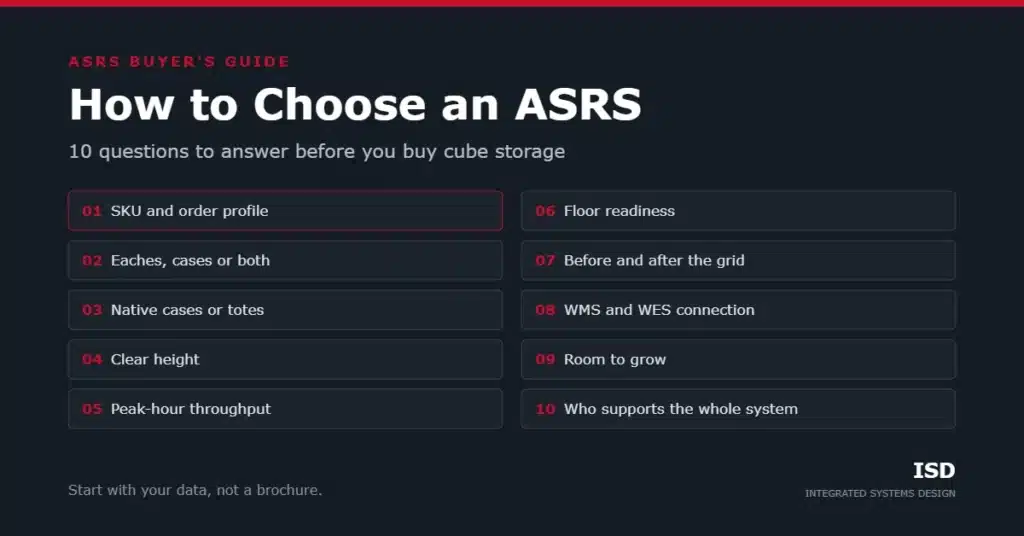
Automated case handling works best when it’s designed around real data. So before you choose a system, gather a few things.
- Case data: Dimensions, weights and packaging condition for your top SKUs. Weak or damaged cartons matter.
- Order profile: How many piece picks, full cases and mixed pallet orders you ship, and when.
- Upstream and downstream flow: Receiving, conveyor, palletizing and shipping need to keep pace with the grid.
- Clear height: URBX grids run from 20 to 125 feet, so your building sets your capacity.
- Software: How orders and replenishment tasks flow from your WMS or WES.
We cover the process side in Focus on Warehouse Processes Before You Plan Your Warehouse Automation. For a full buyer’s checklist, see how to choose an ASRS. For vendor-neutral background on system types, MHI’s ASRS Industry Group is a good place to start. Then our OptimalOps-Process™ turns your data into a design and an ROI model before equipment is specified.
“Case handling touches everything around it: receiving, conveyor, palletizing and the dock. That’s why we design the whole flow, not just the storage grid. Let’s start with your order profile and your case data. Then we can show you where the touches come out of your operation and what that’s worth to you,” said Tony Morgott, President, ISD.
Automated Case Handling: Questions and Answers
What is an automated case handling system?
An automated case handling system stores, stages, buffers and sequences full cases without manual handling. It moves cases from storage to picking, shipping or palletizing in the order they’re needed. The goal is fewer touches, less walking and a steady flow of the right case at the right time.
Can a cube ASRS store cases without totes?
Some can. Many cube systems require cases to be decanted into bins or totes. The URBX AI-Cube ASRS stores native corrugated cases as they arrive, with no totes, trays or carriers. It handles loads up to 100 lbs., including irregular size loads.
How does case handling support automated pallet building?
A palletizer builds better mixed pallets when cases arrive in build order. URBX stores, stages and sequences cases, then releases them to an automated palletizing cell in the order the pallet needs. That helps reduce manual staging between storage and the dock.
Can one system handle both piece picking and cases?
Yes. URBX can run as a split-case picking system, a case handling system or both, in the same grid. Totes support piece picking at goods-to-person workstations, while native cases support storing, staging, buffering and palletizing.
Which industries use automated case handling?
Food and beverage, retail store replenishment, wholesale distribution and third-party logistics often use automated case handling. Manufacturers also use it to store and sequence work in progress between production steps.
Take the Touches Out of Your Case Flow
Send us your order profile and case data, and we’ll show you how URBX could fit your building. Learn more about the URBX AI-Cube ASRS or read What Is Cube Storage ASRS? for the basics. Call 248-668-8250, email information@isddd.com or, better yet, schedule a consultation at your convenience.