By Ed Romaine, Vice President of Marketing
Cube storage vs. shuttle: it’s one of the first questions buyers ask once they decide to automate storage. Both systems bring goods to the operator. However, they’re built in very different ways, and those differences decide which one fits your building and your orders.
At ISD, we design both. So let’s compare them fairly, using the URBX AI-Cube ASRS as the cube storage example.
What Is a Shuttle ASRS?
A shuttle ASRS stores totes, cartons or trays in aisles of rack. A shuttle runs on each level of the aisle and pulls loads from their locations. Lifts at the end of the aisle move loads up and down, and conveyor carries them to pick stations. Most shuttles carry loads of about 100 to 110 lbs.
In other words, the shuttles move loads sideways and the lifts move them vertically, as Modern Materials Handling describes it. Some designs let shuttles change levels on ramps instead of staying on one level. Others store loads several deep.
Pallet shuttles are a different category. They move full pallets through deep lanes of rack. If that’s what you need, see our Pallet Shuttle ASRS guide. Here, we’re comparing URBX with tote and case shuttles.
What Is Cube Storage?
Cube storage packs loads into a 3D grid instead of aisles. In the URBX AI-Cube ASRS, TowerBots travel across the top of the grid and retrieve loads through vertical shafts. GridBots and conveyor then carry them to workstations.
Loads are stored two deep for density. Each shaft keeps open locations, so a front load moves aside in one short move, and there’s no digging through stacks. URBX stores totes, native cases or both, in grids from 20 to 125 feet tall. For the basics, read What Is Cube Storage ASRS?
What Shuttle and Cube Systems Have in Common
Before the differences, let’s look at the common ground. Both systems store loads densely and bring them to an operator, instead of sending people to walk the aisles. Both need software that talks to your WMS or WES, workstations designed around your orders, and conveyor or robots to move loads in and out.
Both also pay off the same way: fewer steps, fewer touches and less floor space per location. So the real question isn’t whether automated storage works. It’s which design fits your order profile and your building’s characteristics.
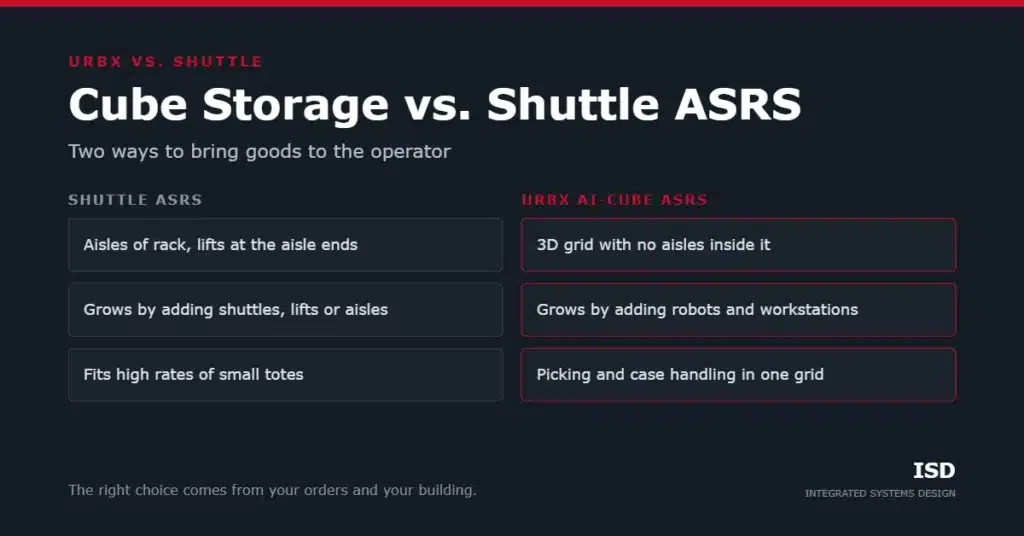
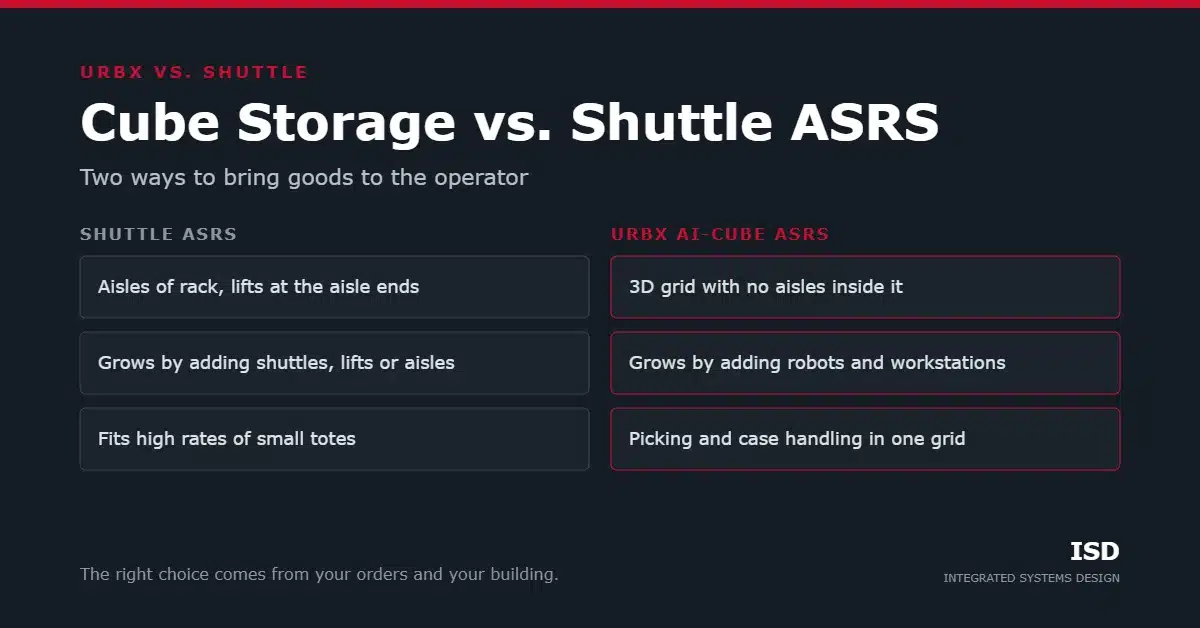
Cube Storage vs. Shuttle: Side by Side
| Shuttle ASRS (tote and case) | URBX AI-Cube ASRS | |
|---|---|---|
| Layout | Aisles of rack, with shuttles on each level and lifts at the aisle ends | A 3D grid with no aisles inside it; robots on top and below |
| Floor space | Aisles take floor space that can’t hold product | The grid uses that space for storage |
| Height | Varies by design; published maximums run to about 65 feet | Grids from 20 to 125 feet tall |
| Loads | Totes, cartons and trays, typically up to about 100 to 110 lbs. | Totes, native cases or both, up to 100 lbs., including irregular size loads |
| Storage depth | Single- or double-deep is common; some designs go deeper | Double-deep, with open locations in each shaft |
| How throughput grows | Add shuttles, lifts or aisles; the aisle lift often sets the limit | Add robots and workstations; sized by simulation |
| Best known for | High throughput of small, frequent orders | Picking, case handling or both in one dense grid |
Neither column wins every row. That’s the point. The right answer depends on what you store, how you ship, the building you have and your business plan.
Where a Shuttle ASRS Fits Best
Shuttle systems are proven, and they’re often the right call. For example, they tend to fit when:
- You need very high throughput of small totes for frequent, small orders.
- Your building is long and lower, so aisles fit naturally.
- You’re expanding an existing shuttle installation and want one system to maintain.
Remember, though, that every load in an aisle passes through that aisle’s lift. Industry coverage notes that the lift at the end of the aisle typically sets the throughput limit per aisle. So lifts, shuttles and aisles have to be sized together.
“When I look at a shuttle design, I look at the lift first. The shuttles can be fast, but every load in that aisle has to go up or down through the lift. So we size lifts, shuttles and aisles together, around your peak hour, not your average day. Get that balance wrong, and the shuttles sit waiting,” said Robert Jones, Senior Consultant, ISD.
Where URBX Fits Best
URBX tends to fit when the job is bigger than picking totes. For example:
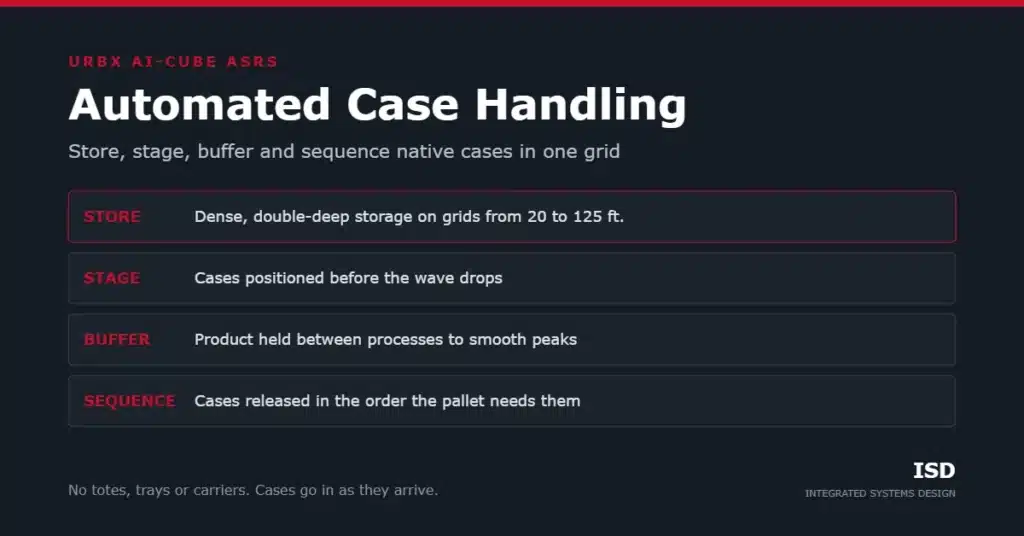
- You need picking and case handling in one system. URBX can run as a split-case picking system, a case handling system or both, in the same grid. We cover that in Automated Case Handling.
- You have height to use. Grids run from 20 to 125 feet, so a tall building can store more in the same footprint.
- Floor space is tight. With no aisles inside the grid, more of the footprint holds product.
- Your loads vary. URBX handles irregular size loads, with tote heights from 5 to 60 inches.
- You expect to grow. Throughput scales by adding robots and workstations.
“Customers usually come in thinking it’s shuttle or cube, pick one. The better question is what your orders look like. If you’re shipping eaches and full cases from the same building, one URBX grid can often do both jobs. If it’s all small totes at a very high rate, a shuttle may be the better fit. Either way, we let the simulation make the call,” said Ryan Morgott, Systems Engineering Consultant, ISD.
URBX vs. Shuttle: How to Decide
So how do you choose? Start with your data, not a brochure. Gather five things first:
- Order profile: Lines per hour at peak, order size and SKU count.
- Load mix: How much ships in totes versus full cases, plus case sizes and weights.
- Building: Clear height, column spacing, shape and floor condition.
- Growth: Where volume and SKU count are headed over the next five years.
- Uptime: How each system keeps running when a lift, shuttle or robot is down for service.
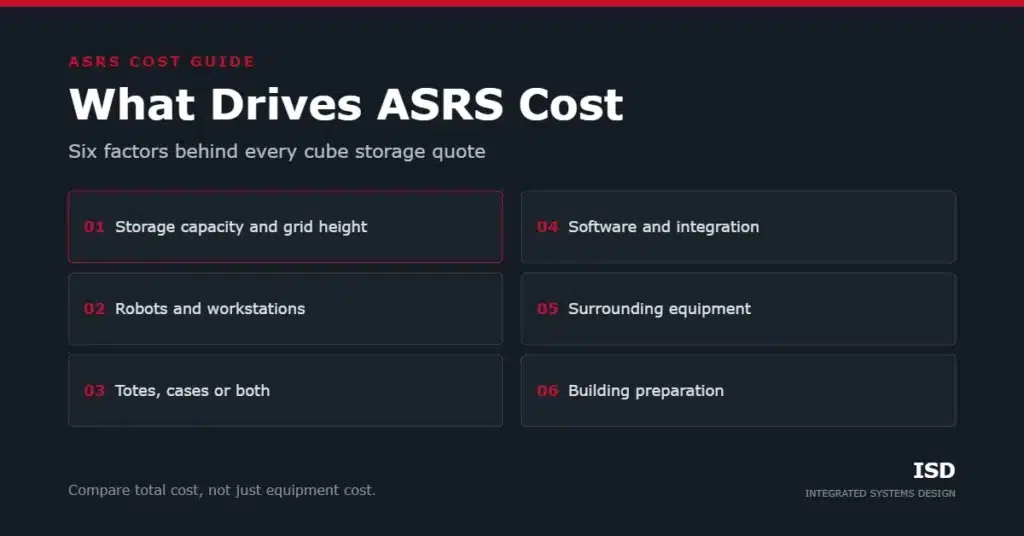
Finally, simulate both against the same orders. Our OptimalOps-Process™ does exactly that before equipment is specified. For a full checklist, see how to choose an ASRS, and for budgeting, our ASRS cost guide. If you’re also weighing crane-based systems, read Mid-Load vs. Mini-Load ASRS. For vendor-neutral background, MHI’s ASRS Industry Group is a good resource. Full disclosure: I serve as the group’s vice chair.
“We design and integrate both shuttle and URBX systems. So we don’t need to win the argument for either one. We model both against your orders and your building, and the data usually makes the choice clear. Sometimes the right answer is both: shuttles for the fastest small totes and URBX for everything else,” said Tony Morgott, President, ISD.
Cube Storage vs. Shuttle: Questions and Answers
What is a shuttle ASRS?
A shuttle ASRS stores totes, cartons or trays in aisles of rack. Shuttles on each level pull loads from their locations. Lifts at the end of the aisle then move them up and down to conveyor and pick stations. Most shuttles carry loads of about 100 to 110 lbs.
Is URBX a shuttle system?
No. URBX is a cube storage system. Robots on top of a 3D grid retrieve loads through vertical shafts, and there are no aisles inside the grid. A shuttle ASRS uses aisles of rack, with shuttles on each level and lifts at the aisle ends.
How does cube storage compare to a shuttle storage system?
Cube storage packs loads into a grid without aisles and scales by adding robots and workstations. A shuttle storage system uses aisles, and throughput often depends on the lift in each aisle. The better fit depends on your orders, load mix and building.
Which has higher throughput, cube storage or shuttle?
It depends on your order profile. Shuttle systems can deliver very high throughput per aisle for small totes, while URBX scales by adding robots and workstations. The only reliable answer comes from simulating both against your own orders.
Can a shuttle ASRS store pallets?
Tote and case shuttles don’t store pallets. Pallet shuttles are a separate category that moves full pallets through deep lanes of rack. ISD’s Pallet Shuttle ASRS guide covers that option.
Get a Straight Answer on Cube vs. Shuttle
Send us your order profile, and our engineers will model URBX and a shuttle system side by side for your building. Call 248-668-8250, email information@isddd.com or, better yet, schedule a consultation.