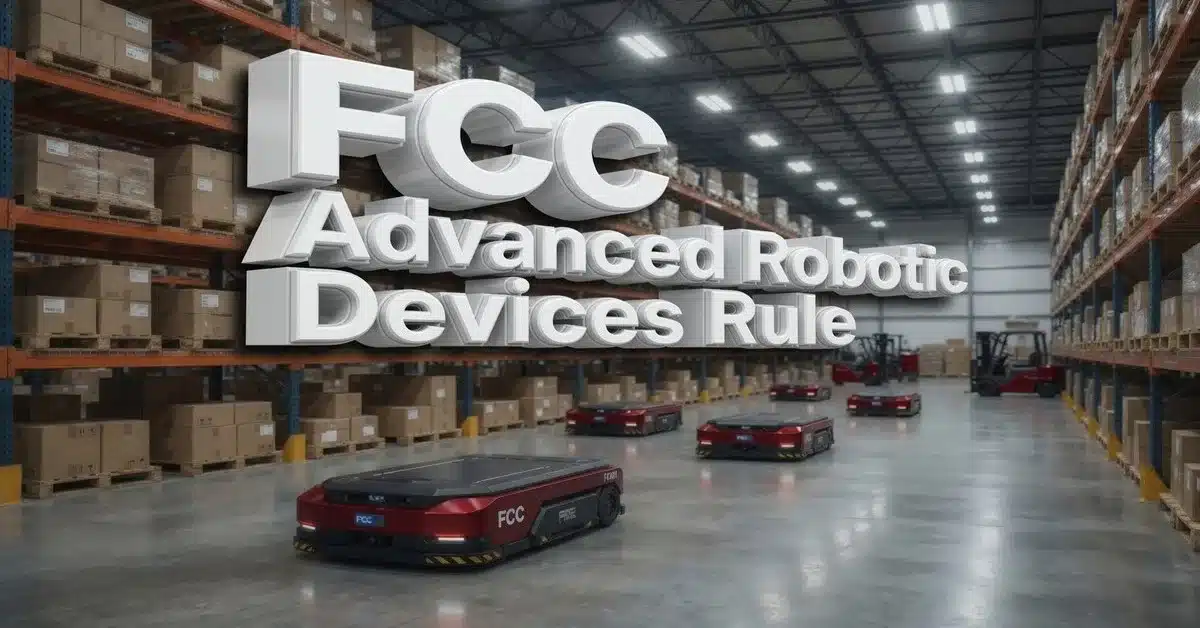
The FCC advanced robotic devices rule is a July 27, 2026 determination that added foreign-produced mobile robots to the FCC’s Covered List, blocking new equipment authorizations on national security grounds. It targets mobile ground robots, including many of the autonomous mobile robots (AMRs) and automated guided vehicles (AGVs) used in warehouse and distribution operations. If you’re planning an automation investment this year, this determination changes how you should evaluate vendors, timelines, and long-term risk.
Updated August 6, 2026. The FCC’s advanced robotic devices determination is one week old as of this writing. Definitions, the Conditional Approval process, and enforcement details are still being clarified by the agency and the Department of War. We will update this page as new guidance is published.
On this page
What the New Rule Actually Covers
The FCC’s determination defines an advanced robotic device using four tests. The device has to be mobile and ground-based. It has to operate away from a human operator, responding to commands or sensor data. It has to weigh more than 4.4 lbs, including any dock or ground station. And it has to combine an environmental sensor, network connectivity of at least 200 kbps, and control software that handles navigation, perception, data collection, or remote command. The agency names quadrupeds, humanoids, and wheeled or tracked ground vehicles as examples.
The determination also spells out clear exemptions. Fixed, stationary industrial robot arms, including articulating, parallel/delta, Cartesian/gantry, and SCARA robots built for industrial or medical use, are explicitly carved out. So are connected vehicles, rail vehicles, drones (covered under a separate December 2025 action), unmanned underwater vehicles, and FDA-regulated medical and mobility devices.
| Likely Covered | Explicitly Exempt |
|---|---|
| AMRs used for goods-to-person, sortation, picking | Fixed robotic arms (articulating, SCARA, delta, gantry) |
| AGVs for material transport | Connected vehicles and rail vehicles |
| Foreign-produced humanoid robots | Drones (covered separately since Dec. 2025) |
| Foreign-produced quadrupeds | FDA-regulated medical/mobility devices |
| Unclear: mobile components within ASRS or shuttle systems | Unmanned underwater vehicles |
“The line the FCC drew matters more than people realize. If your automation depends on a fixed robotic arm, like our Palletizing Module, this rule likely doesn’t touch you. If it depends on mobile robots, you need to know exactly where your supplier’s hardware comes from,”
– says Bob Jones, Senior Consultant at ISD.
Where This Hits Logistics Automation Hardest
Warehouse and distribution operations are where this rule has the most direct reach. According to Interact Analysis, a market intelligence firm covering the robotics and warehouse automation sector, mobile robots used in logistics, including AMRs and AGVs for goods-to-person, sortation, and picking applications, appear to sit squarely inside the FCC’s definition. That’s a large share of the mobile robot fleets deployed in U.S. distribution centers today.
There’s also an open question the industry hasn’t resolved yet. Interact Analysis flagged it directly: it’s still unclear where a mobile robot form factor ends and a fixed automation solution begins, including whether pallet shuttles or mobile components within an automated storage and retrieval system (ASRS) could eventually be swept into the same restriction. DC Velocity reports that integrators are already contacting their international mobile robot suppliers to sort out the implications.
“We tell clients the same thing every time regulation touches equipment sourcing: don’t guess at the edges. If a system in your design has a mobile component, get its authorization status in writing before you commit,”
– says Bob Jones, Senior Consultant at ISD.
What’s Not at Risk Today
This isn’t a recall. Robots already deployed and authorized in the U.S. can keep operating. The FCC has also allowed those existing authorized devices to keep receiving certain software and firmware updates, including security and compatibility updates, through at least January 1, 2029.
The pressure shows up further down the road, when a fleet needs next-generation hardware, a material, firmware, or hardware change, or a new model from a foreign-produced vendor. Those events can trigger re-authorization, and re-authorization for a covered device now runs through a Conditional Approval process that has no published timeline or approval precedent yet.
“Operators shouldn’t panic about the robots on their floor today. They should absolutely start asking harder questions about what happens at the next refresh cycle,”
– says Tony Morgott, President of ISD.
The Real Planning Problem: Terms Still Undefined
The determination leaves several practical questions open, and Interact Analysis’s July 2026 analysis lays them out clearly. What counts as a “new model” isn’t defined, so it’s unclear whether a firmware revision, a hardware refresh, or a rebrand would trigger the block. The Conditional Approval process, which routes applications through the Department of War, has no published review period or approval standard. And the test for “foreign-produced,” tied to the domestic end product definition in federal acquisition regulations, hasn’t been clarified for a robot assembled outside China from a majority-Chinese component set.
That’s precisely the kind of regulatory ambiguity that penalizes operators who committed to a single foreign vendor or a single hardware platform.
“When the rulebook is still being written, flexibility is worth more than the lowest bid. That’s been true in every regulatory shift we’ve navigated with clients over the years,”
– says Bob Jones, Senior Consultant at ISD.
Why an OEM-Agnostic, Made-in-America Approach Is Your Hedge
ISD has been making the case for domestic sourcing and vendor-agnostic system design for a while now, and this determination is a concrete reason why. Read our full breakdown on the Made in America Warehouse Automation page. As an OEM-agnostic integrator, ISD isn’t tied to one robotics manufacturer or one country of origin. That means we can steer a design toward already-authorized, domestically produced, or fixed-automation solutions where they fit the application, without asking you to gamble on a vendor’s Conditional Approval timeline.
It also means fixed automation deserves a fresh look. Our Palletizing Module, built around fixed robotic arms, falls outside this determination entirely. For applications where a fixed-arm solution can do the job a mobile robot was doing, that’s now a genuine risk-reduction argument, not just a cost or footprint one.
“Our whole model is built on picking the best-fit technology instead of being locked into one supplier’s roadmap. Right now, that model is doing exactly what it’s supposed to do for our clients,”
– says Tony Morgott, President of ISD.
Use our warehouse automation ROI calculator to model your options against this new regulatory landscape.
Frequently Asked Questions
Does this rule affect the robots I already have installed?
No. Existing authorized robots can keep operating, and the FCC has allowed continued software and firmware updates, including security updates, through at least January 1, 2029. The restriction applies going forward, to new models and re-authorizations.
Are palletizing robots and robotic arms affected?
Fixed, stationary industrial robot arms, including articulating, SCARA, delta, and gantry robots, are explicitly exempt from this determination. A fixed palletizing cell is not the type of device this rule targets.
What counts as “foreign-produced” under the new rule?
The FCC ties this to the federal “domestic end product” definition, a procurement-law standard built around U.S. content thresholds. As of early August 2026, it’s not yet clear how strictly this will be applied to robots assembled outside China from largely Chinese components. Expect more guidance in the coming months.
What should I ask an automation vendor before signing?
Ask for the FCC authorization status of any mobile robot in the design, where final assembly and critical components are sourced, and what the vendor’s plan is if a future hardware or firmware change requires re-authorization. Get the answers in writing.
Not sure how the new FCC rule affects your automation roadmap?