Considering an automated storage and retrieval system (AS/RS) for your materials handling operation?
These systems offer 5 main benefits on your warehouse operation:
-
- Streamline inventory management
-
- Improve throughput and help you keep up with fluctuating orders
-
- Reduce hiring challenges
-
- Save labor cost
-
- Maximize your available space
-
- Different kinds of automated storage and retrieval systems
-
- What each kind is best suited for
-
- How AS/RS technology combines with other solutions in your warehouse
-
- When an AS/RS solution is financially viable
-
- Examples of AS/RS in warehouses
-
- How to decide if AS/RS is right for you
-
- What the current landscape of AS/RS technology can do
-
- What the best automation candidates are for your operation
-
- What your next steps are (and whether we can help you with a free call to analyze the viability of an AS/RS in your space)
Different kinds of automated storage and retrieval systems
When someone says “AS/RS,” they’re not talking about one specific piece of technology. It’s like saying “mode of transportation.” Do they mean a bus that can carry 100 people or a bike that can carry 1? AS-RS stands for automated storage and retrieval system. It is a type of automated technology that transports materials within the warehouse. An AS/RS combines software systems (like warehouse execution software, or WES, and warehouse management software, or WMS) with material handling hardware (like conveyors, shuttles, cranes, and robots). These computer-controlled automatic systems can be used to put materials away, retrieve items and materials for order fulfillment, and buffer orders, among other uses. But how?That depends on a variety of factors, including:
-
- Item type
-
- Item quantity
-
- Item weight
-
- Velocity
-
- Space
-
- Picking or putting workflows
1) Unit load AS/RS
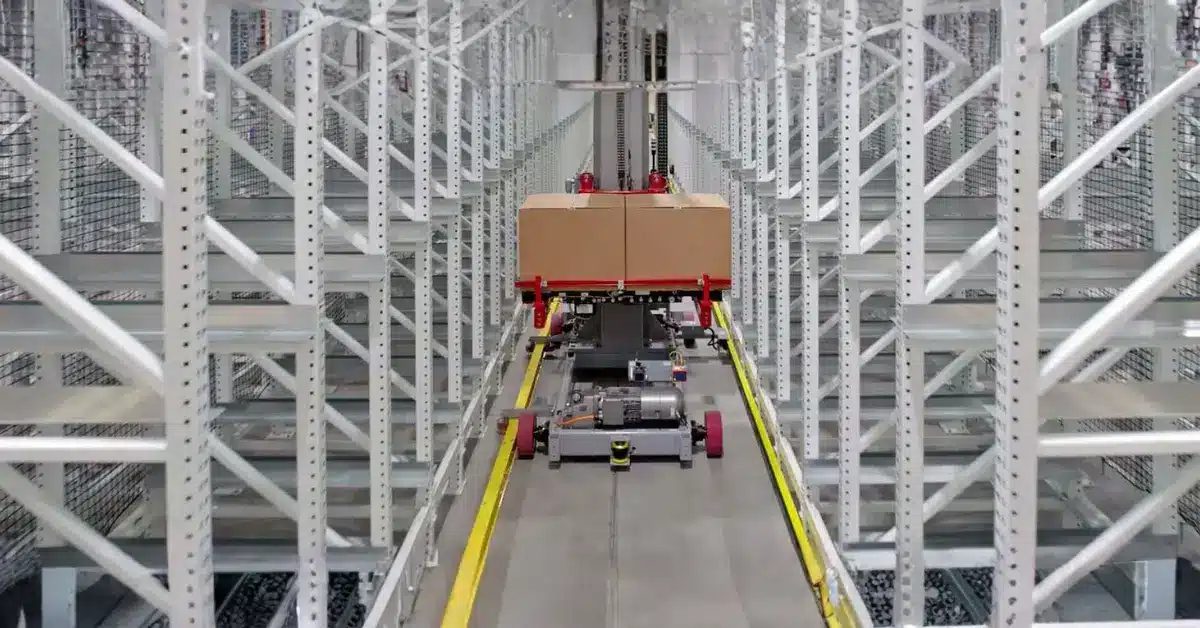
These use narrow aisle racking and cranes to store and retrieve heavy loads of full pallets up in high vertical storage racks. Within unit load AS/RS, also called pallet load AS/RS, there are two subtypes: Fixed aisle systems These include a crane that moves horizontally and vertically within one aisle to store, retrieve, or move pallets. Moveable aisle systems These include a crane that can move between aisles to store, retrieve, or move pallets.2) Mini load AS/RS
These systems store smaller loads, like totes, cases, or trays. They carry less weight than full unit load systems, but otherwise work similarly. They’re best for warehouses with lots of SKUs. Beyond those main two types of AS/RS, there are many variations, including:3) Tote shuttle and pallet shuttle AS/RS
These systems are big in goods-to-person spaces, where shuttles travel independently up and down set rails to retrieve items from storage and bring them to someone packaging them. They’re best in environments with high throughputs. They can be combined with AMRs (autonomous mobile robots), AGVs (automated guided vehicles), and forklifts to transport goods.4) Horizontal and vertical carousel AS/RS
These systems handle smaller items that are picked into bins. Those bins are moved on rotating carousels that can travel sideways (like a merry-go-round) or up and down (like a Ferris wheel). Vertical carousels are often used in operations with limited floor space.5) Vertical lift module (VLM) AS/RS
These systems use inserter/extractors in the center of the long vertical racks of bins to access each needed tray and deliver them to pickers. Once items are picked, the VLM returns the tray to its location. They’re best for high-density storage.When is the cost of an AS/RS solution financially viable?
Not every warehouse needs an AS/RS. Here are 5 indicators that an AS/RS is right for you. Which of them apply to your operation?1) Your operation is running two or three shifts.
Machines cost money to install, but they don’t incur ongoing labor costs in the same way that human labor does. If you can make use of an AS/RS that can work for 16 or 24 hours a day, you’ll see ROI on the technology much faster.2) You currently have 6+ people doing materials handling.
An AS/RS will replace much of the manual labor required to process incoming shipments or pick outgoing orders. If you run a small operation with just a few employees, you may not need the full capabilities of an AS/RS.3) Your labor costs are high or it’s hard to hire.
In union environments and highly competitive hiring environments, AS/RS can make a big difference by reducing your reliance on expensive labor or on people who simply don’t show up for work. If you have easy access to reliable, affordable labor, an ASRS may not make sense for you.4) You work with high-velocity items.
If you have 10 aisles of inventory that can be picked by one person because the velocity of each item is low, certain AS/RS solutions, especially those using heavy machinery like cranes, won’t make sense, because it won’t be viable to put in 10 cranes to travel every aisle. In the case of having 1 person for every 1-2 aisles, you’ll see ROI much more quickly.5) You have unused space in your warehouse.
Automated storage and retrieval systems work in tighter spaces and can go up higher than traditional storage. If you have vertical space that’s not being used, you could add another hundreds or thousands of additional storage spaces, accessible via AS/RS. That way, you could expand your capabilities without needing to refurbish or move facilities.4 examples of automated storage and retrieval systems in the warehouse
An AS/RS solution can make sense for the inventory needs of various industries. Here are 4 examples:-
- A manufacturer of automotive seats used a three-lane AS/RS to store and retrieve completed products for shipping, achieving a throughput of 290 pallets per hour.
-
- A massive distribution center used a goods-to-person AS/RS to process 30,000 items every 8-hour shift, supplementing human workers with automated systems
-
- A manufacturer of cleaning products built AS/RS into their warehouse and installed 15 stacker cranes to navigate storage that can hold up to 161,000 pallets
-
- A distribution center for a beauty company relied on AS/RS to built out four storage levels with 40,000 storage locations that expands storage volumes within a small space
Deciding if ASRS is right for you
To decide if AS/RS is right for you, you need to start by doing a needs assessment. That includes knowing:-
- What type of inventory you’re working with
-
- At what speed you run through products
-
- How many shifts you’re currently working
-
- How much space is available