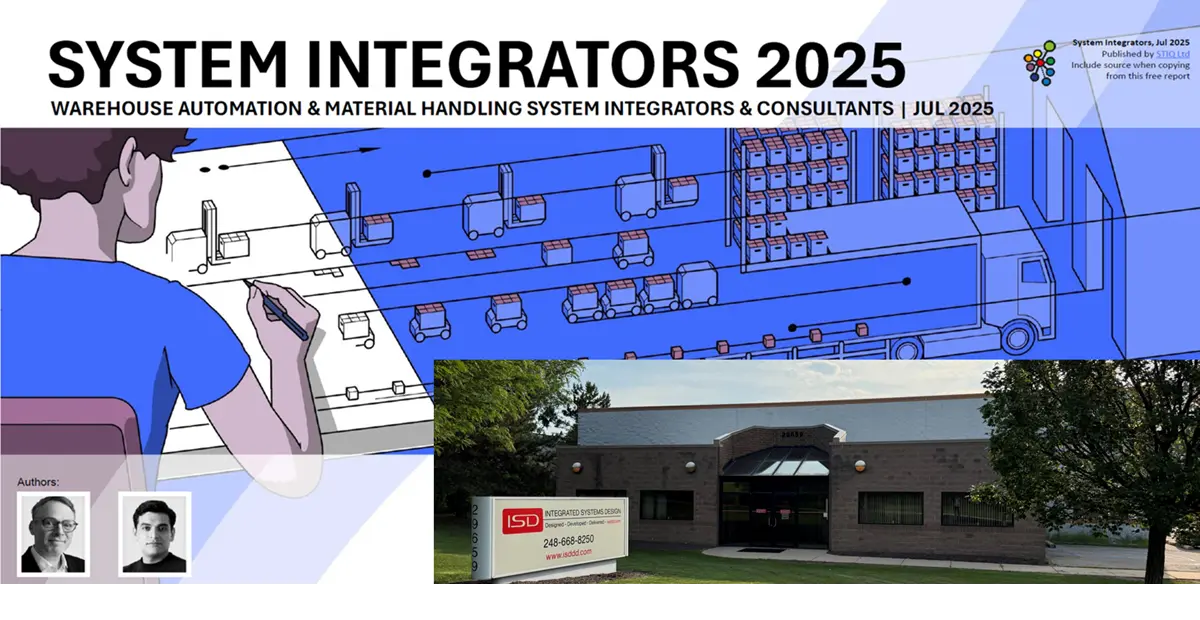
Warehouse automation is no longer a futuristic concept—it is a necessity for businesses aiming to stay competitive in a rapidly evolving market. The 2025 System Integrators report by STIQ Ltd, partially sponsored by ISD, provides a comprehensive overview of the global warehouse automation landscape, highlighting key trends, challenges, and opportunities. This blog explores the insights from the report, focusing on market dynamics, system integrator strategies, and the role of automation in shaping the future of logistics.
Systems Reporting: A Resilient Market Amid Uncertainty
The global warehouse automation system integrator market is projected to reach $33 billion in 2025, despite facing short-term challenges such as geopolitical conflicts and tariff announcements in North America. Chronic labor shortages and the increasing complexity of supply chains continue to drive demand for automation solutions. While the market experienced a slowdown in 2024, growth is expected to return in 2026 and beyond, with an optimistic outlook for the long term.
Key Drivers of Market Growth
Several factors are fueling the growth of warehouse automation:
- Labor Shortages: Chronic labor shortages are pushing businesses to adopt automation to maintain operational efficiency.
- Ecommerce Expansion: Although ecommerce growth has slowed post-COVID, it remains a significant driver for automation, particularly in fulfillment centers.
- Technological Advancements: Innovations in automation technologies, such as Autonomous Mobile Robots (AMRs) and Automatic Storage & Retrieval Systems (ASRS), are improving performance and scalability.
- Customer Knowledge: Businesses are becoming more knowledgeable about automation solutions, enabling them to make informed decisions.
The Role of System Integrators
 System integrators play a crucial role in the warehouse automation ecosystem, bridging the gap between technology providers and end-users. The report categorizes system integrators into three tiers based on project complexity and value:
- Tier 1: Top integrators handling projects exceeding $50-100 million, often involving multiple systems and ERP integration.
- Tier 2: Established integrators managing projects worth $20-40 million, with a focus on software differentiation.
- Tier 3: Emerging integrators and OEMs working on smaller, single-system projects.
The report also highlights the growing trend of “forced partnering,” where integrators collaborate with vendors to mitigate R&D risks and meet market demands for flexible systems.
Regional Dynamics
The dominance of European system integrators is evident, with 54% of the combined revenue of the Top 20 companies originating from Europe. North America accounts for 31%, while Asia contributes 15%. Within Europe, the DACH region (Germany, Austria, and Switzerland) represents 37% of the total revenue, underscoring its leadership in the sector.
Challenges and Opportunities are Detailed in the Systems Integrators Report
Geopolitical Uncertainty
The imposition of tariffs by the US government in 2025 has added a layer of unpredictability to the market. While some companies are adapting by reshoring or diversifying their supply chains, others are postponing projects to assess the long-term impact.
Brownfield vs. Greenfield Projects in The Systems Reporting
The report notes a shift towards brownfield opportunities, where existing facilities are upgraded to incorporate automation. Greenfield projects, while larger in value, are becoming less common due to cost pressures and market uncertainty.
After-Sales Services
After-sales services, including maintenance and support, are a significant revenue stream for system integrators. However, as the sector matures, margins in this area are expected to come under pressure, necessitating cost management strategies.
System Integrators Report: Emerging Trends
RaaS and Modular Automation
The “Robotics-as-a-Service” (RaaS) model is gaining traction, particularly among 3PLs with limited contract durations. Modular automation solutions, which allow businesses to implement individual components like packing or storage systems, are becoming more popular due to their flexibility and scalability.
Customer-Driven Innovation
Retailers like Amazon and Ocado are increasingly viewing warehouse automation as a competitive advantage. Some are even developing their own solutions, blurring the lines between customers and system integrators.
Focus on ROI
The report highlights a growing emphasis on ROI, with customers scrutinizing automation projects more closely. This trend is driven by economic uncertainty and the need to justify investments in automation.
Case Studies: Real-World Applications
Customer One
A non-disclosed customer transitioned from a fully manual warehouse to an automated system, driven by labor shortages and operational inefficiencies. The company opted for a single integrator to manage the project, focusing on customer service and expertise during the evaluation process.
Future Outlook
The warehouse automation market is poised for significant growth, driven by technological advancements and evolving customer needs. However, challenges such as geopolitical uncertainty and tariff impacts will require businesses to adopt flexible and resilient strategies. System integrators will play a pivotal role in navigating these complexities, offering innovative solutions and fostering partnerships to meet market demands.
Systems Integrator Reporting Conclusion
The 2025 System Integrators report offers useful information about the warehouse automation sector, highlighting the resilience and adaptability of the market. As businesses continue to invest in automation, the role of system integrators will become increasingly critical in shaping the future of logistics. By leveraging the latest technologies and focusing on customer-centric solutions, the industry can overcome challenges and unlock new opportunities for growth.
This blog captures the essence of the 2025 System Integrators report, offering a detailed analysis of the warehouse automation market and its key players. For businesses looking to stay ahead in this dynamic sector, understanding these trends and strategies is essential for success.
ISD’s Vendor-Neutral Advantage
As a vendor-neutral systems integrator, ISD offers unmatched flexibility by selecting the right mix of automation technologies based on the needs of each client. Instead of promoting proprietary hardware, ISD evaluates and integrates the most suitable components—whether they’re AMRs, ASRS, conveyors, WMS, AGVs, or shuttles—into a fully integrated and efficient system.
This approach allows ISD to provide customized solutions, independent of any particular brand or manufacturer. Their independence ensures that performance, not brand loyalty, drives the solution. Combined with deep expertise in distribution, warehousing, manufacturing, and assembly operations, ISD creates integrated systems that perform reliably and scale with business growth.
For operations leaders looking for automation that fits their processes—instead of the other way around—ISD is a strategic partner worth contacting. Schedule a no-obligation consultation to explore how ISD can bring efficiency, accuracy, and ROI to your next project.