
OptimalOps-Process eight-step framework helps eliminate guesswork, cuts implementation risk, and delivers automation projects on time and on budget
Wixom, MI / August 2026 – ISD – Integrated Systems Design today highlighted the competitive advantage its proprietary OptimalOps-Process™ delivers to warehouse operators evaluating automation. The eight-step methodology guides every ISD engagement, from initial analysis through ongoing optimization, ensuring clients achieve measurable ROI without the risk of over-engineering or misaligned investment.
Warehouse automation projects fail for a predictable set of reasons: the wrong technology is selected, the implementation is mismanaged, or the workforce is not prepared to operate the new system. OptimalOps-Process was built to help eliminate each of those failure points.
A Framework Built on Eight Disciplines
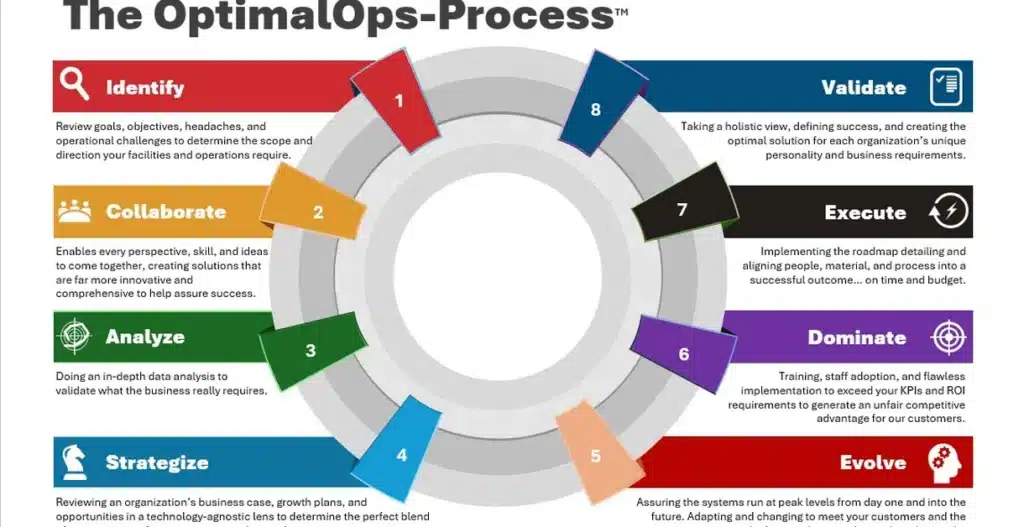
The process begins with Identify, a deep operational analysis conducted before any technology is discussed. ISD engineers examine throughput targets, labor costs, error rates, and spatial utilization. The findings drive the Collaborate step, where ISD works across the client’s organization to build shared ownership of the solution.
Data collected in the Identify and Collaborate phases feeds the Analyze step. ISD uses that data to quantify the financial case for automation. The Strategize step then produces a phased roadmap that balances near-term wins against long-term growth capacity.
Validate ensures the proposed solution aligns with the client’s operational culture before capital is committed. Execute delivers the system with project management disciplines that keep projects on schedule and within budget. Dominate focuses on staff training and KPI achievement. Evolve provides ongoing support and optimization as the client’s business changes.
“No one manufacturer does everything extremely well. In the same facility, we might work with four different manufacturers of a single product alone, because those are what fit best. We tailor the system to your operation, not your operation to the system,” said Tony Morgott, President, ISD – Integrated Systems Design.
Technology-Agnostic by Design
ISD is not tied to any single vendor or product line. The OptimalOps-Process Analyze and Strategize steps evaluate the full landscape of available technologies, including ASRS, AMRs, conveyors, sortation, palletizing, and truck loading. ISD recommends only what the data supports.
That independence helps eliminate a common failure mode in automation projects: an integrator recommending the solution they sell rather than the solution the client needs.
“Customers need a partner who is going to be honest with them. One who will not recommend the easiest solution, but the right one,” said Morgott.
Measurable Customer Outcomes
ISD clients using the OptimalOps-Process framework have documented results, including doubled throughput capacity, 30% recovery of floor space for future expansion, and labor cost reductions exceeding $600,000 annually. Automation projects typically complete on time and on budget, a standard ISD sets as a baseline expectation, not a stretch goal.
“The OptimalOps-Process takes the guesswork out of automation. Clients have a clear picture of what they are getting, what it will cost, and what their return will be before a single piece of equipment ships,” said Ed Romaine, VP Marketing & Business Development, ISD – Integrated Systems Design.
Applicable Across Industries and Project Scales
The eight-step process scales from first-time automation deployments to complex greenfield build-outs. It applies across distribution, manufacturing, 3PL, food and beverage, automotive, and healthcare verticals. Project timelines typically range from four to 18 months depending on scope.
ISD supports clients through the full lifecycle: design, procurement, installation, commissioning, training, and ongoing support available 24/7/365.
Q&A: Understanding the OptimalOps-Process
What makes OptimalOps-Process different from how other integrators approach automation projects?
Most integrators start with a product catalog. OptimalOps-Process starts with an operational analysis. Technology is not discussed until ISD has a complete data picture of what a client actually needs. That sequence helps prevent over-engineering and misaligned investment.
Does OptimalOps-Process work for smaller warehouses, or is it designed for large distribution centers?
The framework scales to any project size. The eight steps are the same whether ISD is automating a 50,000-square-foot facility or a 500,000-square-foot campus. The depth of analysis and the technologies recommended change based on operational data, not facility size.
How does ISD ensure automation projects stay on time and on budget?
The Execute step includes dedicated project management with milestone tracking, risk escalation protocols, and single-point-of-contact accountability. ISD manages vendor relationships, installation sequencing, and commissioning, with one partner responsible for the outcome.
What happens after the warehouse automation system is installed?
The Evolve step establishes ongoing support and optimization. ISD offers 24/7/365 service and revisits system performance as a client’s business grows or changes. The goal is a long-term operational partnership, not a one-time transaction.
About ISD – Integrated Systems Design
ISD is a warehouse automation systems integrator and OEM manufacturer headquartered in Wixom, Michigan. ISD designs, engineers, and installs automated material handling systems, including ASRS, conveyors, palletizers, truck loading and unloading systems, sortation, and AMRs, guided by its proprietary OptimalOps-Process™ framework. Automation Where It Counts.