
Understanding inventory slotting and its impact on warehouse operations is crucial for determining whether inventory is considered a fixed asset, as well as differentiating inventory vs. supply and exploring various warehouse slotting strategies and optimization.
Effective inventory slotting is key to improving warehouse efficiency and reducing picking time. Many ask, “Is inventory a fixed asset?“—while it’s a valuable resource, inventory is classified as a current asset, not fixed. Understanding inventory vs. supply helps businesses balance what’s on hand versus what’s in transit. If you’re wondering what is warehouse slotting, it’s the process of organizing products in a warehouse for optimal accessibility and flow. This blog explores proven warehouse slotting optimization techniques and warehouse slotting strategies that can boost productivity and accuracy. Have you ever wondered why some warehouses seem to operate like well-oiled machines while others struggle with constant inefficiencies? The secret often lies in one critical process that many businesses overlook: inventory slotting. This strategic approach to organizing your warehouse can be the difference between thriving in today’s competitive market and falling behind your competitors.
Inventory slotting isn’t just about putting products on shelves – it’s a sophisticated methodology that can transform your entire operation. From reducing labor costs to maximizing storage space, proper slotting techniques can revolutionize how your warehouse functions.
What is Warehouse Inventory Slotting Optimization?
Inventory slotting is the strategic process of modeling and positioning inventory vs. supply based on specific item characteristics within your warehouse or distribution center. Think of it as creating a personalized address system for every product in your facility, where each item’s location is determined by scientific analysis rather than random placement. The question of whether inventory is a fixed asset plays a key role in shaping slotting best practices, influencing how items are categorized, stored, and accessed within the warehouse.
This process takes into account multiple factors, including item velocity (how often items are picked), total sales volume, physical dimensions, weight, item classifications/types, and even seasonality patterns. By analyzing these characteristics, businesses can create an optimized layout that minimizes travel time for pickers, maximizes space utilization, and improves overall operational efficiency.
The beauty of inventory slotting lies in its data-driven approach. Instead of relying on gut feelings or traditional methods, you’re using concrete metrics to make informed decisions about where each product should live in your warehouse.
Why is Inventory Warehouse Slotting Optimization Critical for Your Business?
Understanding the importance of inventory and warehouse slotting optimization is crucial for any business serious about warehouse optimization. The impact extends far beyond simple organization – it touches every aspect of your warehouse operations.
Inventory Slotting and its Impact on Pick Rates and Order Fulfillment
Here’s a startling fact: picker travel time represents the majority of total pick time in most warehouses, upwards of 75%. When you consider inventory slotting to be the single largest factor affecting pick rates, the importance becomes crystal clear.
Imagine your warehouse as a city and your pickers as commuters trying to get to work. Would you rather have them take scenic routes through quiet neighborhoods or efficient highways that get them to their destination quickly? Proper slotting creates highways in your warehouse, reducing unnecessary travel and dramatically improving productivity.
Inventory vs Storage Space Utilization Benefits
Most warehouse managers would be shocked to learn that their facilities often achieve less than 30% bin utilization on average. This means that 70% of the available storage space within bins remains unused! Effective inventory slotting addresses this waste by ensuring products are matched to appropriately sized storage locations.
Throughput and Capacity Improvements
When your warehouse slotting optimization is properly slotted, the ripple effects are enormous. You’ll see improvements in overall throughput capacities, increased SKU storage capacity, enhanced process accuracy, and more efficient put-away and replenishment activities. It’s like upgrading your warehouse’s operating system.
The Three Pillars of Effective Inventory Slotting
Successful inventory slotting rests on three fundamental criteria that must work together harmoniously:
- Item Picks
- Item Sales
- Item Cube
Let’s explore each pillar in detail.
Item Picks – Understanding Velocity Classifications
Item picks represent the “velocity” of a product – essentially how fast it moves through your warehouse. But here’s where many people get confused: picks are different from sales volume. A pick refers to how many times an item is accessed in a location or appears as a line item on a pick ticket, regardless of the unit quantity of the product to be picked.
This distinction is crucial because it directly impacts picker workload and travel patterns. An item that’s picked 100 times for single units creates far more work than an item picked once for 100 units, even though the sales volume is identical.
Warehouse Slotting Strategies: ABC Classification System Explained
Is inventory a fixed asset? The ABC classification system is your roadmap for organizing inventory vs. supply by velocity. This system typically breaks down as follows:
- A Items: High-velocity products that represent a small percentage of total items but account for a large percentage of picks
- B Items: Medium-velocity products with moderate pick frequency
- C Items: Lower-velocity products picked less frequently
- D Items: Slow-moving inventory with minimal pick activity
- E Items: Dead inventory – inventory vs. supply that rarely or is never picked.
Be aware that in many facilities, the D & E items can be 70-90% of the total SKU count
Sales Volume Analysis
Sales volume represents the total number of units processed through your facility over a specific timeframe. This metric works together with cube dimensions to determine the size requirements for stocking locations.
It’s important to note that sales volume doesn’t typically affect ABC velocity classifications directly. While purchasing and finance departments may use their own ABC classifications based on inventory vs. supply, is a fixed asset, and its value or sales revenue, warehouse operations should focus on “pick” frequency for optimal slotting decisions.
Cube Dimensions and Physical Specifications
Cube refers to the physical dimensions of the smallest unit of sellable measure for each item. Every product requires minimum specifications, including length, width, height, and weight. This information is essential for calculating total storage requirements and determining appropriate bin sizes.
Units of Measure Considerations
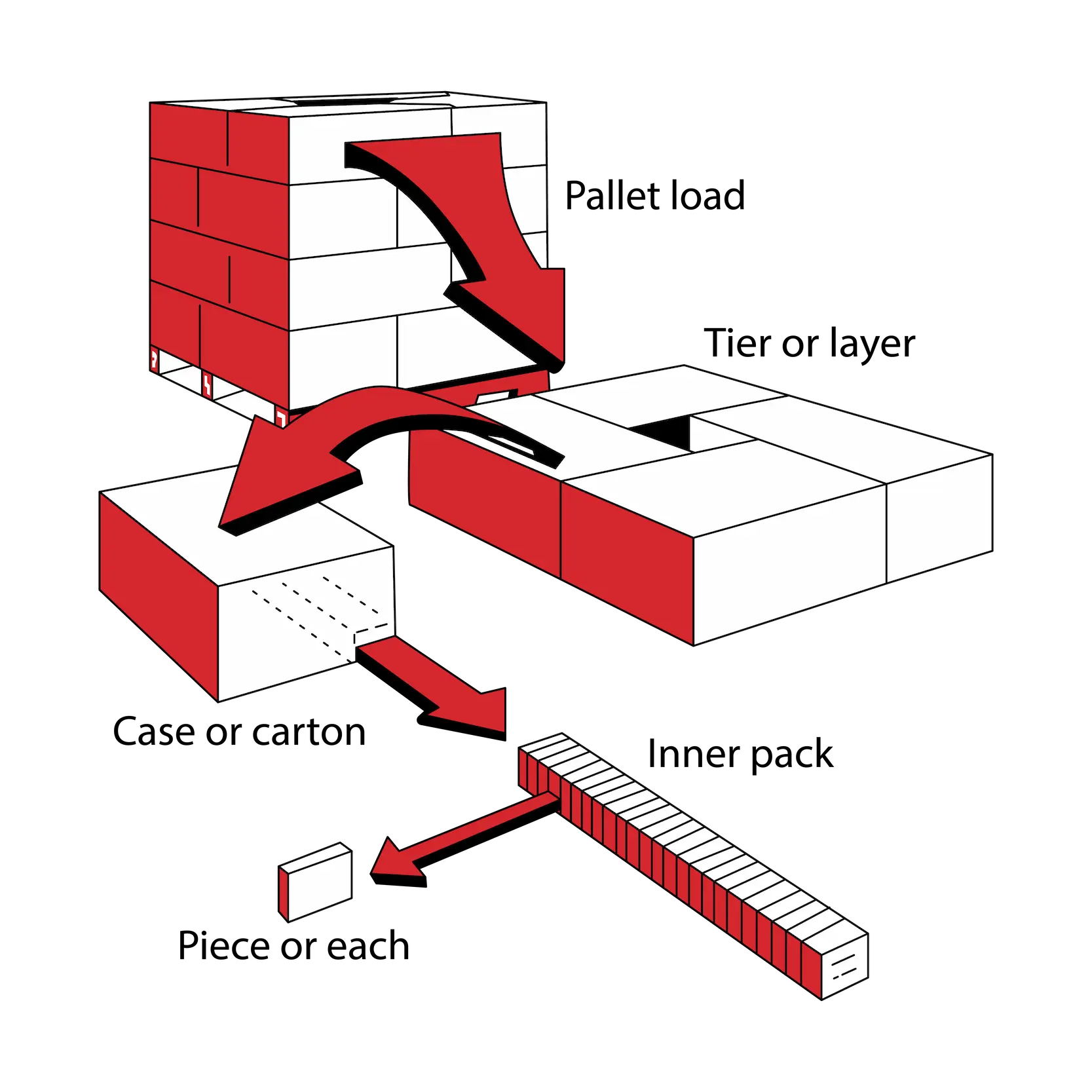 Different units of measure beyond the smallest sellable unit should also be considered when necessary. These might include boxes, inner cases, cases, pallets, and other packaging configurations. Your warehouse management system should account for all these variations to ensure accurate slotting decisions and the most efficient picking.
Picks vs Sales: Understanding the Critical Difference
Let’s illustrate this crucial concept with a practical example that demonstrates why picks and sales tell different stories about your inventory vs. supply. Understanding whether inventory is a fixed asset is essential when developing slotting best practices, as it helps optimize space and improve the efficiency of warehouse operations.
Real-World Examples of Pick Velocity
Consider two items, both with identical sales profiles:
Item A: 1,000 pieces stored on a pallet, 1,000 units sold monthly, picked one piece at a time (1,000 picks per month), valued at $10 per unit.
Item B: 1,000 pieces stored on a pallet, 1,000 units sold monthly, picked as full pallets (1 pick per month), valued at $10 per unit.
From a financial and purchasing perspective, these items appear to be identical. However, from a warehouse slotting optimization and operations standpoint, they couldn’t be more different. Item A requires 1,000 picker visits monthly, making it a high-velocity A-class item. Item B requires only one pick monthly, classifying it as a D-class item.
This example perfectly illustrates why pick frequency, not sales volume or sales revenue, should drive your slotting decisions.
ABC Inventory Mapping and Classification
Understanding how ABC classification distributes across your inventory provides valuable insights for slotting optimization.
Distribution Analysis of Inventory vs Supply Classes
A typical warehouse slotting optimization might see the following distribution pattern: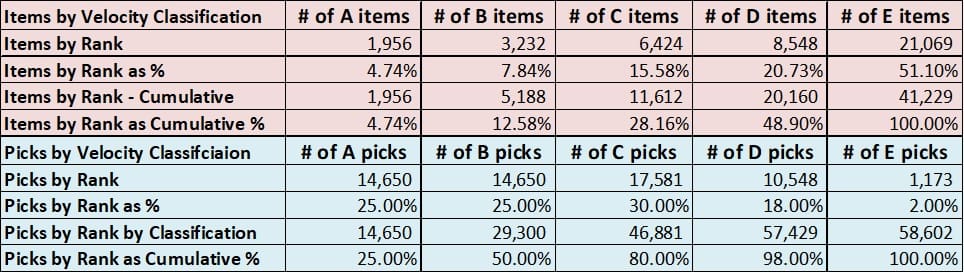
- A Items: 4.74% of total items generating 25% of all picks
- B Items: 7.84% of total items generating 25% of all picks
- C Items: 15.58% of total items generating 30% of all picks
- D Items: 20.73% of total items generating 18% of all picks
- E Items: 51.10% of total items generating only 2% of all picks
Notice the dramatic difference between item count and pick activity. The fastest-moving 12.58% of the inventory SKUs (A and B items combined) accounts for 50% of all picking activity. If there were 20,000 skus total, only 2,516 SKUS would account for 50% of the pick volume. This insight should drive your layout decisions, ensuring these high-velocity items are positioned in the most accessible, efficient locations.
Bin and Cell Slotting Strategies
Bin slotting focuses on properly sizing items to their storage containers, maximizing utilization while minimizing wasted space.
Maximizing Storage Utilization
The goal of bin slotting is straightforward: use as much of your storage medium as possible with minimal waste. However, achieving this goal requires careful analysis and planning.
Most companies that claim to be “out of space” are actually out of “locations”, not physical storage capacity. With average bin utilization below 30%, there’s enormous opportunity for improvement through better slotting practices.
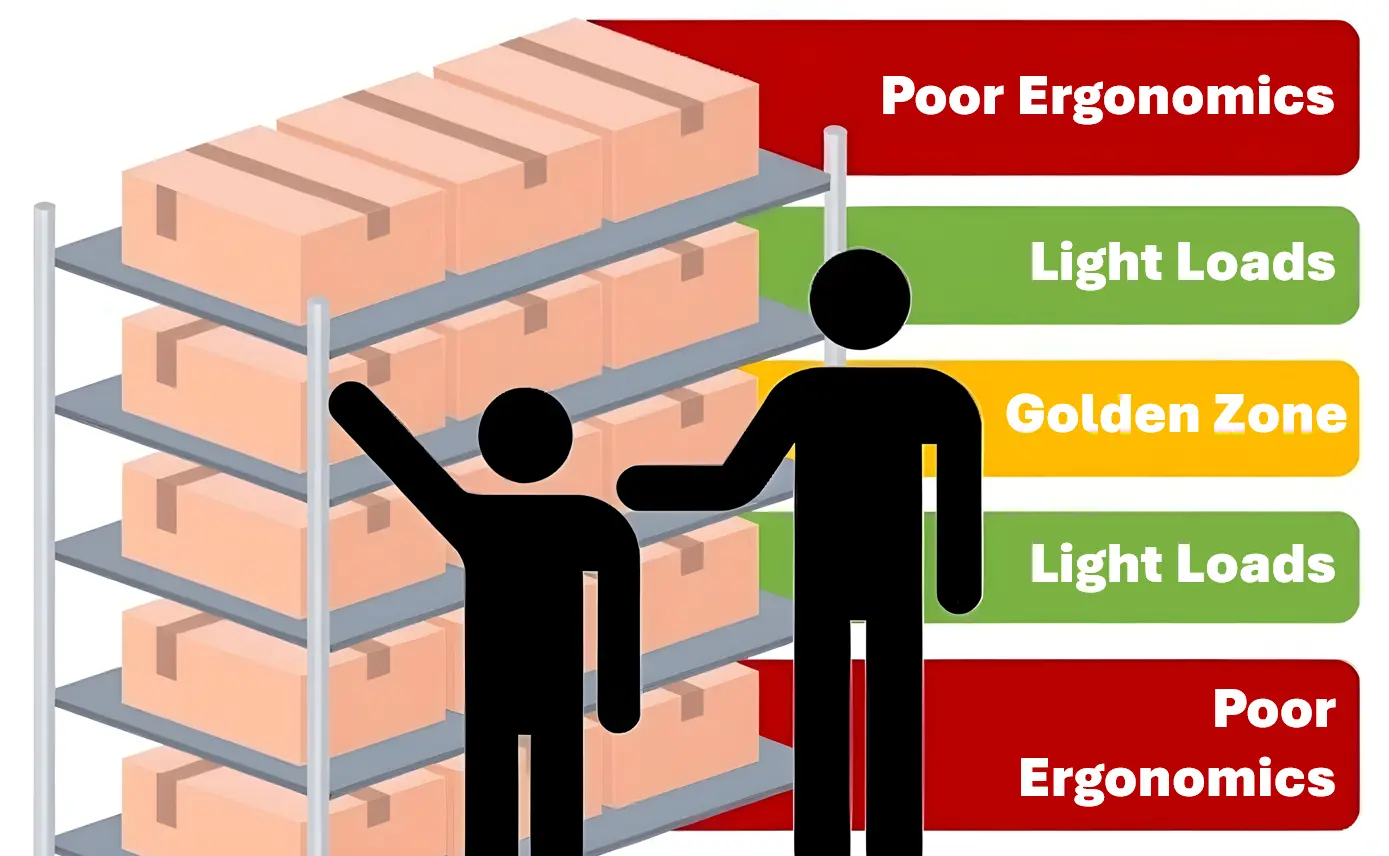
Inventory Slotting Requirements and Calculations
Effective bin slotting requires several key pieces of information:
- Number of units processed within a specific timeframe
- Smallest sellable unit dimensions (length, width, height)
- Available bin specifications and internal storage dimensions
- Weight considerations for bin and shelf capacity limits
Remember, velocity determines where bins are located within your system, not the bin size itself. High-velocity items should be placed in easily accessible areas regardless of their storage requirements.
Slotting Theory and Best Practices, Inventory vs Supply
The theoretical foundation of inventory slotting follows a logical progression that ensures optimal space utilization.
Size Optimization Techniques
The slotting process follows these steps:
- Determine the smallest bin where every dimension of the item fits comfortably
- Calculate the total sales cube to verify the bin can accommodate expected inventory levels
- If the bin cannot hold the required volume, move up in bin sizes until adequate capacity is achieved
- Consider alternative storage mediums for larger or faster-moving items that may require multiple bins
- Is inventory is a fixed asset that can not be overlooked.
This methodical approach ensures each product is matched to its ideal storage solution while maintaining efficiency and accessibility.
Creating a Complete Warehouse Map
A comprehensive warehouse slotting optimization map integrates bin sizes, velocity classifications, and strategic positioning to create an optimized layout.
Velocity-Based Zone Design
Your warehouse map should contain bins organized by size within velocity-class zones throughout the distribution center. Items are first slotted into appropriate velocity areas, then assigned to correctly sized bins within those zones.
“Think of your warehouse as a city planning project,” advises Bob Jones. “You want your ‘downtown business district’ – the high-traffic, easily accessible areas – reserved for your A and B items. Your C, D, and E items can live in the ‘suburbs,’ where space is more abundant, but accessibility is less critical.”
Pay special attention to different units of measure, as cases may require different picking processes than individual units. This consideration affects both location strategy and operational procedures.
Common Slotting Challenges and Solutions
Even the best slotting strategies encounter challenges that require careful consideration and planning.
Key challenges include determining baseline metrics for bin sizing (should you use current sales, quantity on hand, or future purchase projections?), managing items that can be split across multiple smaller bins (important for FIFO compliance), handling large purchases that may cover extended periods, and dealing with slow or dead inventory that consumes valuable cube space.
Fixed vs Random Storage Locations
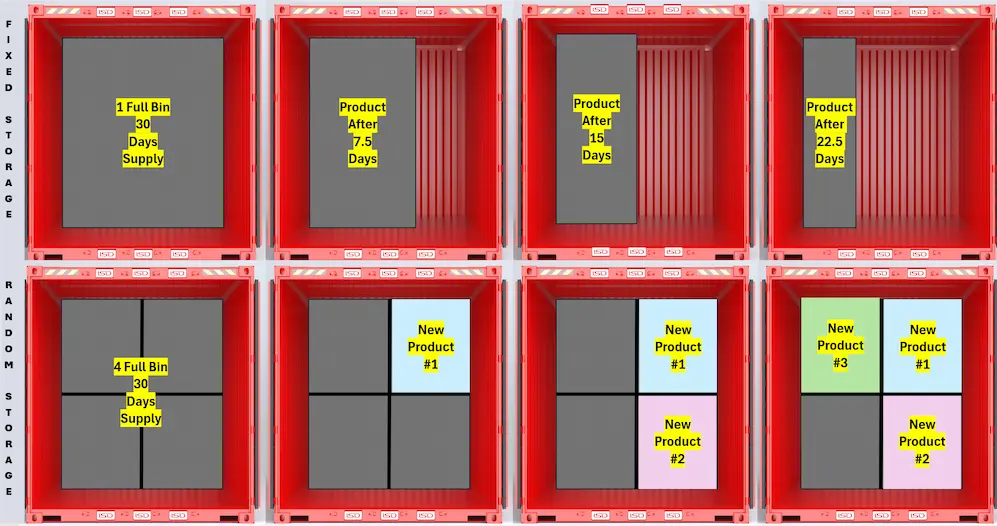
The choice between fixed and random storage locations significantly impacts your slotting strategy. Fixed storage provides consistency and predictability, making it easier for pickers to learn locations and reducing training time. However, random storage offers better space utilization, natural FIFO enforcement, and improved inventory control.
Purchasing Algorithm Considerations
Understanding your purchasing algorithms is crucial for effective slotting. For example, if an item sells 40 units monthly with a one-week lead time, your purchasing schedule might require stocking 40 total units to maintain service levels. Safety stock, vendor consistency, special buys, and order minimums all affect space requirements and must be factored into slotting decisions.
The Value of Working with Professional Systems Integrators
While understanding inventory slotting principles is crucial, implementing an effective slotting strategy often requires specialized expertise that goes beyond internal capabilities. This is where professional systems integrators like Integrated Systems Design (ISD) become invaluable partners in your optimization journey.
Why Choose a Systems Integrator for Inventory Slotting
Systems integrators bring a unique perspective that’s “not limited to one brand, product, or solution.” Companies like ISD take a comprehensive approach, understanding your operational requirements, customer expectations, and growth opportunities before recommending specific solutions.
As Bob Jones, Senior Consultant, explains, “The biggest mistake I see companies make is trying to implement slotting optimization in isolation. Successful slotting isn’t just about moving products around – it’s about understanding how every decision impacts your entire operation, from labor costs to customer satisfaction.”
The ISD Approach to Warehouse Slotting Optimization
“Observing, asking questions, gathering data, and assessing your individual situation is how ISD begins consulting engagements.” This methodical approach ensures that slotting recommendations are based on real operational data rather than theoretical models.
Bob Jones emphasizes this point: “Too many businesses approach slotting with a one-size-fits-all mentality. At ISD, we’ve learned that every warehouse has unique characteristics – from building layout to product mix to customer demand patterns. Our role is to identify these nuances and create slotting strategies that work specifically for your operation.”
Beyond Basic Slotting: Integrated Solutions
What sets professional integrators apart is their ability to see beyond individual improvements to comprehensive system optimization. In order to “discover automation possibilities, show how those chances contribute to accomplishing your operational objectives, and describe future steps,” ISD’s professionals “produce deliverables, including reports and presentations.”
“Inventory slotting is just the beginning,” notes Bob Jones. “When we analyze a client’s warehouse, we’re looking for opportunities to integrate slotting improvements with automation, workflow optimization, and technology upgrades. The goal is to create a solution that doesn’t just fix today’s problems but positions you for future growth.”
Proven Results from Professional Implementation
The results speak for themselves. ISD has helped customers in making significant improvements: “A large health and beauty company redesigned their 250,000 square foot fulfillment center using ISD automation, adding ASRS to cut down on human picking and storage and vertical cube storage to recover floor space. They saw their ROI in 18 months through saved labor costs.”
Bob Jones shares additional insights: “We recently collaborated with a client who thought they needed to expand their facility because they were ‘out of space.’ Through proper slotting analysis and system integration, we increased their storage capacity by 40% and improved pick rates by 60% – all without adding a single square foot of building space.”
Implementation Tips for Successful Inventory Slotting
 Successfully implementing inventory slotting requires careful planning, exact data, and ongoing optimization. Start by gathering comprehensive data on item dimensions, pick frequencies, and sales volumes. Invest in warehouse management systems that can support dynamic slotting calculations and provide real-time visibility into space utilization.
Bob Jones recommends a phased approach: “Don’t try to revolutionize your entire warehouse overnight. Start with your highest-velocity items – your A and B classifications. Get those optimized first, measure the results, and then expand the program. This approach builds confidence and demonstrates ROI quickly.”
Regular analysis and adjustment are essential, as business patterns change over time. What works today may need refinement tomorrow, so build flexibility into your slotting strategy from the beginning.
Consider the human element as well. Your team needs training and buy-in to make slotting successful. Communicate the benefits clearly and provide the tools and support necessary for smooth implementation. Likewise, the classification of inventory vs supply as a fixed asset can significantly affect slotting best practices, determining how items are prioritized, stored, and retrieved within the warehouse.”
Slotting Conclusions
Inventory slotting represents one of the most impactful yet underutilized strategies for warehouse slotting optimization. By understanding the critical differences between picks and sales, implementing proper ABC classifications, and optimizing bin utilization, businesses can achieve dramatic improvements in efficiency, space utilization, and operational costs.
The key to success lies in taking a data-driven approach that considers all three pillars: item picks, sales volume, and cube dimensions. When these elements work together within a well-designed warehouse map, the results speak for themselves through improved pick rates, better space utilization, and enhanced overall productivity.
However, as Bob Jones emphasizes, “Success in inventory slotting isn’t just about understanding the theory – it’s about having the expertise to implement these concepts effectively within your unique operational environment. That’s where partnering with experienced systems integrators like ISD can make the difference between modest improvements and transformational results.”
Remember, inventory slotting isn’t a one-time project – it’s an ongoing process that requires regular analysis and adjustment. But for businesses willing to invest time and effort, or partner with professional integrators who bring proven expertise, the returns are substantial and long-lasting. “When refining inventory slotting methods, companies must first clarify if inventory is a fixed asset, as this distinction can drive both cost management and space utilization strategies.”
Frequently Asked Slotting Questions
Q1: How often should I review and update my inventory slotting strategy?
A: Most successful warehouses review their slotting strategy quarterly, with major overhauls annually. However, high-growth businesses or those with seasonal fluctuations may need more frequent adjustments. The key is monitoring performance metrics and making data-driven decisions about when changes are needed.
Q2: What’s the biggest mistake companies make when implementing inventory slotting?
A: According to Bob Jones, Senior Consultant, “The most common mistake is focusing solely on sales volume instead of pick frequency. Many businesses slot their inventory based on financial metrics rather than operational requirements, leading to inefficient picker routes and reduced productivity.” Additionally, trying to implement too much change at once without proper planning or professional guidance often leads to disruption and poor results.
Q3: What’s the difference between inventory vs supply in warehouse management?
A:3: Understanding inventory vs. supply helps improve planning and reduce stock issues. Inventory is what a business currently has in stock—ready for use or sale. Supply refers to how goods are sourced and replenished. Inventory is the “what’s on hand,” while supply is the flow that keeps stock levels steady.
Q3: Can small warehouses benefit from inventory slotting, or is it only for large operations?
A: Inventory slotting benefits operations of all sizes. Even small warehouses can see significant improvements in efficiency and space utilization. The principles remain the same regardless of scale – it’s about matching products to optimal locations based on their characteristics.
Q4: How do I manage seasonal inventory in my slotting strategy?
A: Seasonal inventory requires flexible slotting that can accommodate changing demand patterns. Consider creating designated seasonal zones that can be repurposed throughout the year and build seasonal factors into your ABC classifications to ensure proper placement during peak periods.
Q5: What technology do I need to implement effective inventory slotting?
A: While sophisticated warehouse management systems can automate slotting calculations, you can start with basic tools like spreadsheets to track item dimensions, pick frequencies, and sales data. However, Bob Jones recommends, “If you’re serious about long-term optimization, invest in professional analysis from systems integrators like ISD who can help you understand not just what technology you need, but how to integrate it effectively with your existing operations.” The most important element is accurate data collection and analysis, whether through simple tools or advanced software.
Q6: Is inventory a fixed asset?
A: When evaluating slotting best practices, it’s important to first determine if inventory is a fixed asset, as this classification affects both storage decisions and overall warehouse slotting optimization.
While these benefits are compelling, the challenge remains: how to specify, find, afford, and implement the necessary systems to achieve these goals. This is where ISD can help. By helping to find the correct system(s) and processes that are the best operational fit for your operation and focusing on optimizing labor performance and costs, your operation can achieve substantial efficiencies while increasing capacity and accuracy and reducing reliance on non-value-added functions.
If you have any questions or wish to explore potential solutions tailored to your company, please feel free to reach out to schedule a no-obligation consultation.