
The UltraStore Mini-Load ASRS stores and retrieves totes and bins with proven mini-load ASRS storage density and throughput. No embedded track. No single point of failure. No proprietary parts. You get reliable performance, simplified maintenance, reduced capital investment, and rapid ROI.
This system delivers the storage density you need without the complexity that drives up ownership costs. Your operations team gets consistent throughput. Your maintenance team gets easy access to standard components. Your CFO gets faster payback.
ISD designed the UltraStore Mini-Load ASRS from 60 years of ASRS experience and decades of manufacturing and implementing hundreds of UltraStore Mid-Load ASRS systems. We eliminated the pain points that plague traditional ASRS and mini-load systems. The result: automated tote and bin storage that fits your budget and keeps running.
The UltraStore Mini-Load ASRS is an automated storage and retrieval system engineered for high-density tote and bin handling. It shares the proven architecture of ISD’s flagship UltraStore Mid-Load system but optimizes for smaller load units.
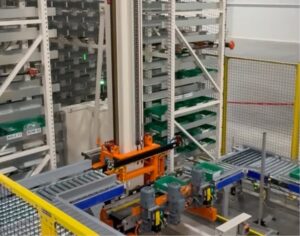
The system stores totes and bins in vertical racking structures. Inserter/extractor bots retrieve items on demand and deliver them to picking stations, conveyors, or AMRs. Your team picks orders. The system returns containers to storage. The cycle repeats hundreds and thousands of times per shift.
You use the UltraStore Mini-Load ASRS to consolidate inventory into a smaller footprint. You eliminate wasted floor space. You reduce operator walking and searching time. You increase picking accuracy. You scale capacity vertically instead of horizontally.
The system integrates with your warehouse management systems (ERP, MES, WMS, WES) through standard protocols to ISD’s Advanced WCS software. Your MES/WMS sends pick requests. The UltraStore Mini-Load ASRS retrieves the right bins. Your operators’ complete picks. Inventory updates automatically. No manual intervention required.
Implementation starts with analysis of your storage and throughput requirements. ISD’s OptimalOps-Process identifies the right system configuration for today, tomorrow and future. We design the layout. We install the system. We train your team. We provide 24-7-365 service. You start running production.
 The UltraStore Mini-Load ASRS delivers measurable operational improvements from day one. You reduce labor requirements. You increase storage density. You improve accuracy. You scale without adding floor space.
The UltraStore Mini-Load ASRS adapts to diverse storage and retrieval applications. Distribution centers use it for small parts picking. Manufacturers use it for component storage. E-commerce operations use it for order fulfillment.
The UltraStore Mini-Load ASRS comprises several integrated subsystems. Each component contributes to reliable operation and easy maintenance.
Storage Structure: The vertical racking system uses standard warehouse rack components. No precision or custom steel fabrication required. Rack heights adapt to your building constraints.
Inserter/Extractor: Automated shuttles move horizontally and vertically to access storage locations. The system uses commercial motion control components.
Tote Handling: Standard totes and bins fit the system. You’re not locked into proprietary containers. The system handles multiple tote sizes in the same structure. This flexibility supports diverse product ranges.
Control System: Industrial PLC architecture provides reliable control. The system uses proven automation platforms. System diagnostics identify issues before they cause downtime.
Software Integration: Open architecture integrates the Advanced UltraStore Mini WCS software to any warehouse management system. Standard protocols eliminate custom interfaces. Real-time status reporting keeps your WMS synchronized. You maintain inventory accuracy.
Safety Systems: Multiple safety zones protect operators. Light curtains prevent unauthorized access. Emergency stop controls position strategically. The system meets ANSI safety standards.
Power Distribution: Energy-efficient drives reduce operating costs. Standby mode minimizes power consumption during idle periods. You reduce utility expenses.
Pick Workstations: Pick stations integrate with multiple technologies such as pick-to-light, weigh scales, RF scanning, printers, auto baggers, dunnage systems, box erectors, shipping software and virtually any other technology required. Ergonomic design reduces operator fatigue. One or more workstations support your throughput requirements.
The UltraStore Mini-Load ASRS transforms your storage and picking operations. You gain control over costs, space, and accuracy.
Multiple industries deploy the UltraStore Mini-Load ASRS to solve specific operational challenges. Each industry values different system capabilities.
Successful implementation requires careful planning. ISD’s OptimalOps-Process guides you through critical decisions.
Throughput Requirements: Calculate your peak hourly retrieval needs. The system scales to match your volume. Underestimating throughput creates bottlenecks. Overbuilding wastes capital. ISD’s analysis ensures right-sizing.
SKU Profile: Document your product dimensions and storage requirements. Container standardization simplifies system design. Mixed SKU profiles need careful planning. We optimize tote sizing for your products.
Building Constraints: Measure ceiling heights accurately. Structural capacity matters for vertical storage. Floor levelness affects installation costs. We design around your facility limitations.
Integration Requirements: Your WMS capabilities determine integration complexity. Legacy systems may need middleware. API documentation speeds implementation. We work with all major WMS platforms.
Growth Planning: Consider three-year volume projections. Modular design allows expansion. Plan for future capacity now. You avoid costly retrofits later.
Operational Workflow: Map current processes before automating. Identify improvement opportunities. Plan for change management. Your team needs proper training.
Maintenance Capabilities: Assess your team’s technical skills. Basic troubleshooting happens in-house. Complex repairs may need support contracts. We provide comprehensive training.
Budget and ROI: Calculate total cost of ownership. Include installation, training, and ongoing costs. Document labor savings and productivity gains. Most projects pay back in 18-36 months.
The UltraStore Mini-Load ASRS accepts distinct options to match your operational requirements. You configure the system for your specific needs.
The UltraStore Mini-Load ASRS scales to your requirements. Standard configurations accommodate most applications. Custom designs address unique needs.
Specification | Metric | Imperial |
Tote Capacity | 500-5,000+ positions | 500-5,000+ positions |
System Height | 6-15 meters | 20-50 feet |
Tote Load Capacity | Up to 25 kg | Up to 55 lbs. |
Throughput | 100-400+ totes/hour | 100-400+ totes/hour |
Tote Dimensions | 400-600mm L x 300-400mm W | 16-24 in L x 12-16 in W |
Power Requirements | 480V 3-phase | 480V 3-phase |
Picking Accuracy | 99.9%+ | 99.9%+ |
Typical Footprint | 50-500 m² | 500-5,000 sq ft |
*All specifications are nominal and subject to change without notice.
ISD welcomes custom configurations to accommodate specialized requirements. Contact us to discuss your specific application.
ISD brings over 60 years of material handling experience to your project. We’ve designed and installed decades of automated systems. Our track record speaks for itself.
Our OptimalOps-Process ensures right-sizing. We analyze your actual requirements. We don’t oversell capacity you don’t need. We design systems that match your budget and performance goals.
We’re OEM agnostic. We will pick the best components for your application. We’re not tied to single suppliers. You get proven technology at competitive prices.
We manufacture the UltraStore product line. We understand the equipment intimately. Our engineers designed it. Our technicians maintain it. You get factory-direct support.
We provide complete lifecycle support. Initial consultation leads to design, installation, training, and ongoing maintenance. One company handles everything. You avoid coordination headaches.
Our team includes former warehouse managers and operations directors. We understand your challenges. We’ve walked your floors. We design solutions that work in real operations.
We maintain inventory of critical spare parts. Your downtime gets minimized. Emergency support responds quickly. We keep your system running.
The ISD service network provides North American coverage. Our technicians travel to your site. Remote support handles many issues. You get help when you need it.
The UltraStore Mini ASRS is engineered for high-density tote and bin handling without embedded track or proprietary parts. Inserter/extractor bots travel vertically and horizontally within standard racking to deliver inventory to pick stations on demand.
WMS or ERP pick requests go to the Advanced WCS software. Inserter/extractor bots retrieve the correct tote or bin and deliver it to the pick workstation. After pick confirmation, the system returns the container to optimal storage automatically.
Unlike systems with embedded floor track, the UltraStore Mini rides on the floor surface — eliminating single points of failure, precision floor leveling, and reducing maintenance costs by up to 40% through standard off-the-shelf components.
The UltraStore Mini recovers up to 75% of floor space and eliminates up to 66% of manual picking labor, typically delivering payback periods of 18 to 36 months.
The UltraStore Mini delivers 99.9%+ picking accuracy through automated tote retrieval, with optional weight scales, barcode scanners, and pick-to-light displays for additional verification.
The UltraStore Mini serves e-commerce, spare parts, pharmaceuticals, electronics, automotive, medical devices, and manufacturing replenishment — handling 500 to 5,000+ tote positions at 100 to 400+ totes per hour.
Installation completes in 8 to 12 weeks with no embedded track required. Open architecture WCS integrates with virtually all WMS and ERP platforms, and your facility stays operational during installation.
Contact Us for More Information About UltraStore Mini-Load ASRS